
Chemistry Doesn't Care How Careful You Are
Mixing cleaning products is not a rookie mistake. It happens to experienced cleaners, professional janitorial staff, and cautious homeowners. You spray an acidic cleaner on a surface that still has bleach residue. You dump the contents of one spray bottle into another to "save space." You think you're using two products that look and smell similar. The reaction happens in seconds, fills a small bathroom with toxic gas, and sends you to the ER.
Every combination on this list is genuinely dangerous. We're not including "reduces effectiveness" pairs — we're focused on the ones that can hurt you. Read the whole list, then think about what's currently under your sink.
What You'll Need
- Labeled, dedicated spray bottles — one product per bottle, clearly marked. Never reuse a bottle without washing it out completely.
- A list of active ingredients — know what's in your cleaners, especially for any product containing bleach, ammonia, or acids.
- Gloves and eye protection — when working with any commercial-strength product.
- Good ventilation — open windows and fans, especially in small spaces like bathrooms and closets.
- Access to fresh air — and a clear exit route in case you need to evacuate.
The Combinations That Can Hurt You
1. Bleach + Ammonia = Chloramine Gas
This is the classic and arguably most common dangerous mix. Ammonia is found in many glass cleaners, some floor cleaners, some multi-surface cleaners, and even urine (relevant for cleaning pet accidents). When ammonia meets bleach, the reaction produces chloramine gas, which irritates the eyes, nose, and lungs immediately. Higher concentrations cause chest pain, shortness of breath, and long-term lung damage.
Real-world scenarios: Cleaning a toilet with bleach while wiping the surrounding tile with an ammonia-based glass cleaner. Mopping a pet accident with bleach. Combining "boost" products in a spray bottle.
2. Bleach + Vinegar (or Any Acid) = Chlorine Gas
Bleach reacts with any acid — vinegar, lemon juice, citric acid, some toilet bowl cleaners, rust removers, and some bathroom cleaners — to release chlorine gas. This is the same gas used as a chemical weapon in World War I. Low-level exposure causes coughing and burning eyes. Higher exposure causes chemical burns to the lungs.
Real-world scenarios: Adding vinegar to a bleach-water bucket to "boost" cleaning power. Spraying a vinegar solution on a surface still wet with bleach. Using a toilet bowl cleaner (often acidic) right after scrubbing with bleach.
3. Bleach + Rubbing Alcohol = Chloroform and Other Toxic Compounds
Mixing bleach with isopropyl alcohol produces chloroform, hydrochloric acid, and a cocktail of chlorinated compounds. Exposure causes dizziness, nausea, and in high concentrations, loss of consciousness. Long-term exposure is linked to liver and kidney damage.
Real-world scenarios: Disinfecting a countertop with alcohol wipes after bleach cleaning. Using alcohol-based hand sanitizer while handling bleach.
4. Hydrogen Peroxide + Vinegar = Peracetic Acid
Individually, these are both safe household products. Mixed directly, they form peracetic acid — corrosive enough to cause chemical burns on skin and irritate the lungs and eyes. The peracetic acid also degrades surfaces quickly.
Note: Using them sequentially (spray one, wipe, then spray the other) is generally safe and is actually a recommended disinfection technique for cutting boards. The danger is in mixing them in the same container.
5. Different Brands of Drain Cleaner
Many commercial drain cleaners contain either bleach-based or acid-based ingredients. Mixing them — even pouring one after the other into a clogged drain — can cause the drain to erupt with boiling, caustic liquid. Always use one drain cleaner, wait for it to work (or fail), and flush thoroughly with water before trying another.
6. Bleach + Toilet Bowl Cleaner
Most toilet bowl cleaners are strongly acidic (hydrochloric acid, phosphoric acid, or sulfuric acid). Mixing them with bleach is one of the fastest ways to generate chlorine gas in a small, often poorly ventilated bathroom. Even the residue from one product can react with the other.
7. Ammonia + Drain Cleaner (Caustic Soda)
Some drain cleaners contain sodium hydroxide (lye). Mixing with ammonia creates a vigorous reaction that can splash caustic material and release ammonia vapor.
Pro Tips
- One product at a time. Finish, rinse thoroughly, let the surface dry, then move on.
- Label your bottles. Every spray bottle should be clearly labeled with the product name and dilution ratio.
- Don't mix "to save space." Combining leftover products into one container is one of the most dangerous things you can do.
- Read the labels. Know if your cleaners contain bleach, ammonia, or acids. If you can't tell, assume they do and don't mix.
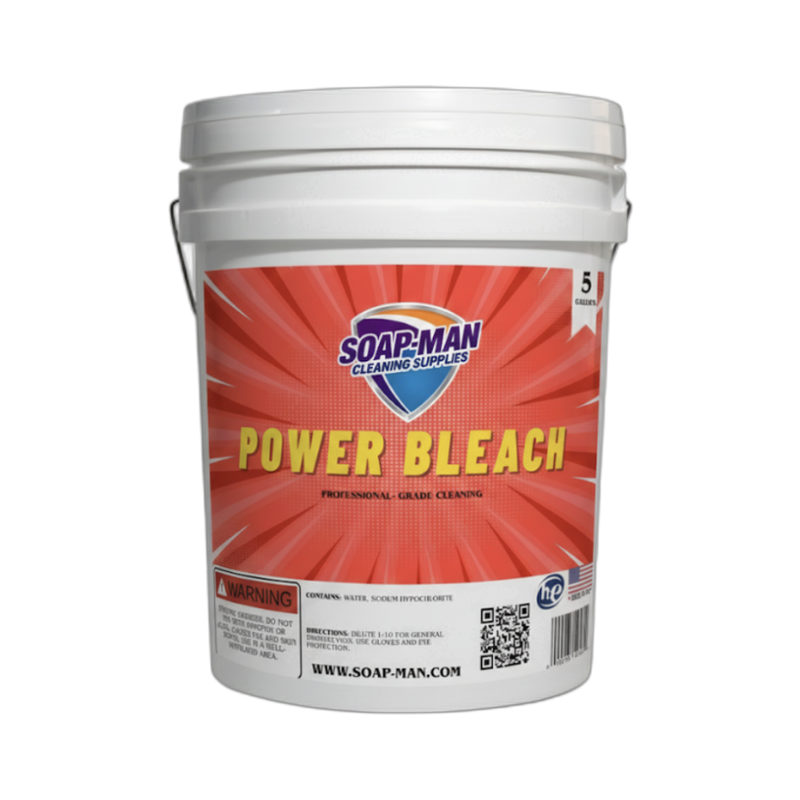
- Use bleach by itself. Power Bleach is powerful enough to handle most disinfection tasks without needing another product alongside it.
- Ventilate before, during, and after. Open windows, run fans, and leave the room if you notice any unusual smell.
Common Mistakes
- Assuming "natural" products are safe to mix. Vinegar, lemon juice, and hydrogen peroxide are all reactive with other cleaners.
- Using one product right after another without rinsing. Residue is enough to trigger a reaction.
- Refilling empty bottles with a different product. Trace amounts of the old product can react with the new one.
- Ignoring a sudden chemical smell. If you smell something sharp during cleaning, leave the room immediately and ventilate.
- Cleaning in a small, closed bathroom with multiple products. Even when individual products are fine, fumes can build up.
- Using bleach on a surface previously cleaned with an ammonia-based product. The ammonia residue is still reactive.
What to Do If You've Already Mixed Something
If you notice a strong chemical smell, coughing, burning eyes, or trouble breathing during cleaning:
- Leave the area immediately. Get outside or to a well-ventilated space.
- Don't try to clean up the reaction. Open windows, turn on fans, and stay away until the fumes clear.
- Call Poison Control at 1-800-222-1222 (U.S.) for guidance.
- Seek medical attention if symptoms persist. Chest tightness, persistent cough, or difficulty breathing warrant an ER visit.
- Do not re-enter until fully ventilated. Wait until you can no longer smell anything unusual.
FAQ
Can I use bleach and vinegar on the same day?
Yes, but only if you rinse thoroughly between them and let surfaces dry. Use bleach first, rinse with plain water, wait for the surface to dry, then apply vinegar. Even better: use them on different days or in different rooms.
Are "green" cleaners safe to mix with each other?
Not necessarily. Many natural cleaners contain vinegar, citric acid, or hydrogen peroxide — all of which can react with other products. "Natural" is not a synonym for "safe to combine."
What about mixing two different brands of the same type of cleaner?
Risky. Manufacturers don't disclose every ingredient, and two "all-purpose cleaners" from different brands can have incompatible chemistries. Stick to one product per surface per session.
Is it safe to mix dish soap with bleach?
No. Dish soap contains ammonia compounds and other ingredients that can react with bleach. Even if the reaction isn't immediately dangerous, it degrades the effectiveness of both products and can release low-level fumes.
What if I smell bleach after using a different cleaner — does that mean I mixed them?
Possibly. If you used a cleaner in an area where bleach was previously used and the surface wasn't rinsed, you may be generating low levels of chlorine compounds. Ventilate immediately, leave the area, and avoid using the two products in sequence without proper rinsing.