Commercial Disinfectant — Bulk Sodium Hypochlorite for Real Sanitation Programs
Soap-Man ships 12.5% sodium hypochlorite (Power Bleach) in 4×1-gallon cases and 5-gallon buckets from East Orange, NJ — paired with the cleaning chemistry you actually need to make disinfection work. Same-week tri-state delivery, pallet pricing at 24 units, and a buying guide that says what most distributors won't.
Buy disinfection as a program, not a bottle
Commercial disinfectant is the most over-promised, under-applied category in janitorial. The product on the shelf does the chemistry. The protocol around it — clean first, dilute right, hold the contact time — does the disinfection. Operators who treat disinfectant as a single SKU on a re-order form rarely get the result they paid for.
Soap-Man's bulk disinfectant is Power Bleach — 12.5% sodium hypochlorite at pH 11.5–12.5, shipped in 4×1-gallon cases and 5-gallon buckets. It is the same active chemistry that municipal water systems, food-service operators, and laundry programs have used for decades. We sell it in concentrate so you control dilution by zone and by risk level — sanitation-strength in food prep, general-purpose in offices, laundry-bleach strength on whites.
This page tells you what Power Bleach is, where it belongs in a facility, what to pair it with (the cleaning step matters as much as the disinfecting step), and where to look elsewhere if your operation needs a different chemistry class — quat, phenolic, or accelerated hydrogen peroxide. We carry one disinfecting chemistry. We'd rather route you to the right answer than oversell ours.
A three-SKU disinfection program
One disinfectant. Two cleaners. Run the cleaning step first, then the disinfecting step — the protocol most distributors forget to sell you.
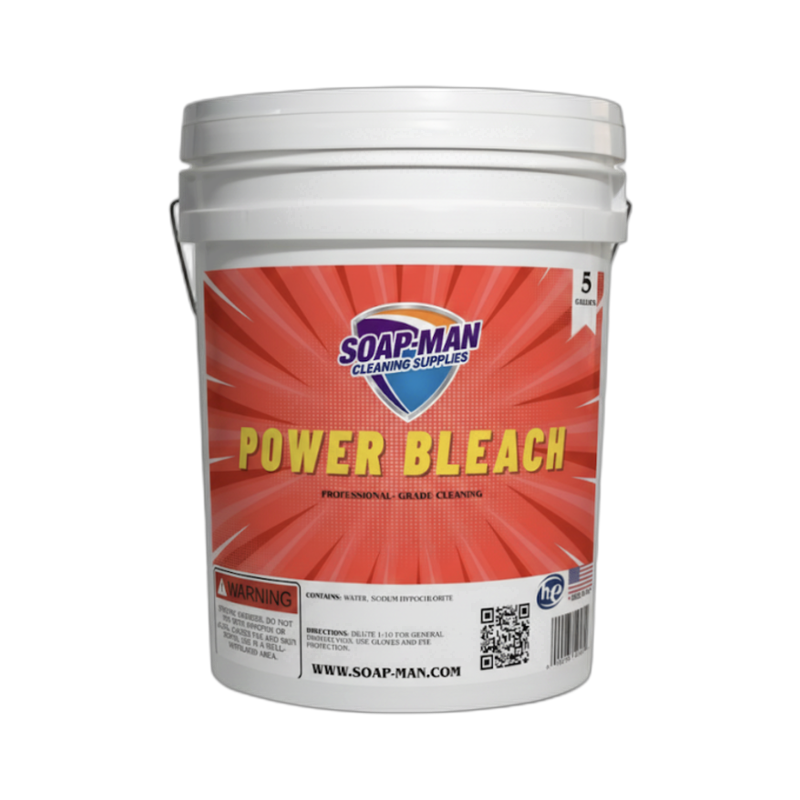
Power Bleach (12.5% NaOCl)
Bulk sanitizing + whitening agent
12.5% sodium hypochlorite · pH 11.5–12.5 · dilute 1:10 for sanitation, 1:100 for general use
Restroom fixtures, food-prep floors, laundry whitening, grout lines, mop-bucket sanitation, water treatment dosing. Use after a cleaning step — soils neutralize hypochlorite on contact.
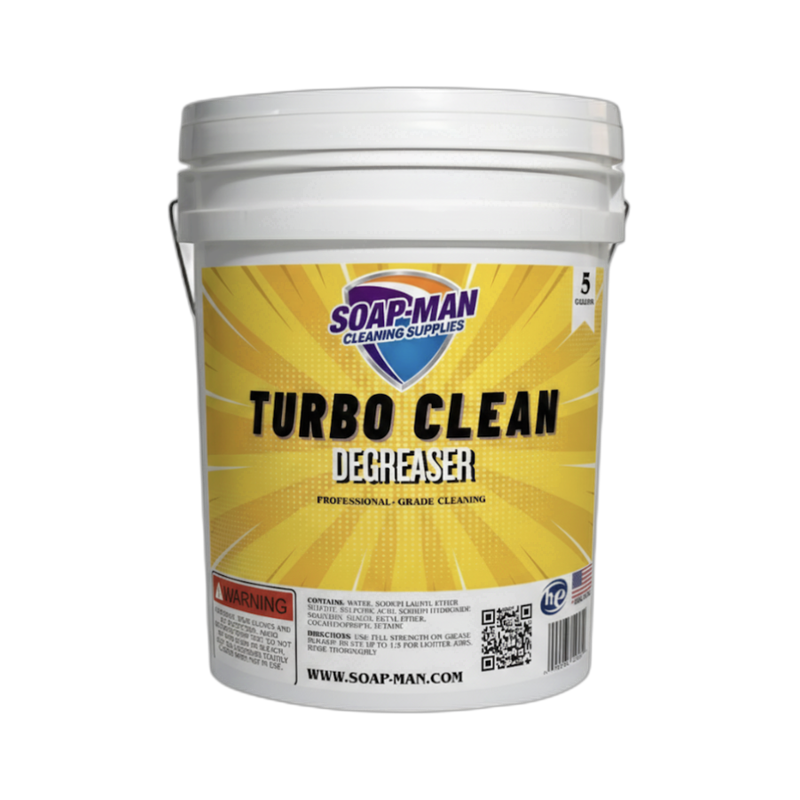
Turbo Clean Degreaser
Heavy alkaline pre-clean before disinfection
pH 12–13 · 1:10 to 1:50 dilution · non-flammable · food-service safe
Required first step on grease, biofilm, or organic soil — disinfectant only works on a pre-cleaned surface. Use on quarry tile, raw concrete, stainless prep tables, fryer surrounds.
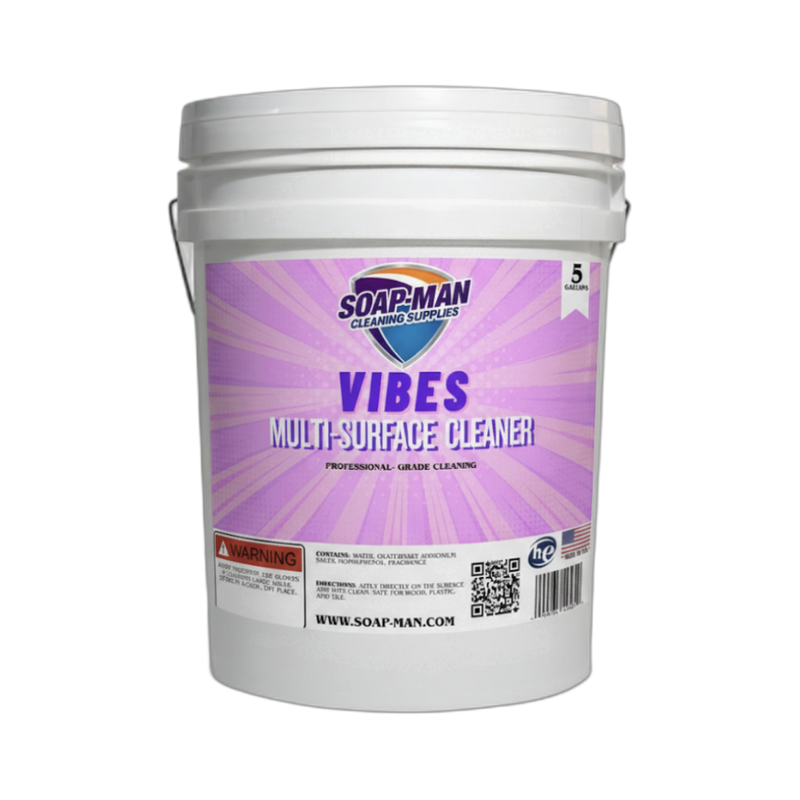
Vibes Multi-Surface Cleaner
Neutral daily clean before disinfecting touchpoints
pH 9–10 · 1:32 to 1:64 dilution · streak-free · safe on sealed substrates
Daily wipe-down on door handles, light switches, counters, exam-room surfaces, gym equipment. Removes the organic film that would otherwise blunt Power Bleach contact-time efficacy.
Six things to verify before standardizing a commercial disinfectant
Chemistry class, two-step protocol, dilution, dwell time, substrate compatibility, and shelf life — the specifics buying managers actually need before approving a SKU.
Match chemistry class to the soil and surface
Sodium hypochlorite (chlorine bleach, Power Bleach) is the workhorse for porous and non-porous surfaces — grout lines, food-prep floors, mop water, laundry. Quaternary ammonium ('quat') compounds are common in ready-to-use sprays and wipes. Phenolic chemistry and accelerated hydrogen peroxide round out the catalog. Soap-Man's bulk catalog focuses on sodium hypochlorite for high-volume sanitation programs.
Clean first, disinfect second — every time
Hypochlorite, quats, and phenolics all lose efficacy on a dirty surface. Visible soil, grease, and organic film consume the active ingredient before it can reach pathogens. CDC and most state health departments require a two-step protocol on health-sensitive surfaces: detergent clean, water rinse, then apply disinfectant at label dilution and hold the full contact time. Skip step one and your contact-time math is fiction.
Dilution ratio drives both efficacy and cost
Power Bleach at 1:10 (about 1.25% available chlorine) is a sanitation strength used in food service and locker-room programs. 1:100 (about 0.125%) is a general-purpose surface-wipe strength. Lower the dilution and the product runs longer but works slower; raise it and you burn through inventory while increasing corrosion risk on stainless and grout sealant.
Contact time is non-negotiable
Disinfectants work by contact, not by spraying. Surfaces must stay visibly wet for the full label dwell time — typically 5 to 10 minutes for sodium hypochlorite at sanitation strength. Wiping too soon means the surface was rinsed, not disinfected. Build dwell time into the route, not the rinse.
Substrate compatibility limits your options
Sodium hypochlorite is hard on bare aluminum, copper, brass, and unsealed natural stone (marble, travertine, slate). Extended contact dulls polished stainless and degrades some grout sealants. Quats are gentler on metals but break down on cotton fibers — they're poor in cleaning-cloth bucket systems. Always verify the surface before standardizing.
Storage, shelf life, and freight class
12.5% sodium hypochlorite has a roughly 6-month effective shelf life when stored cool and out of UV. Heat and sunlight degrade available chlorine within weeks. It ships under UN3082 packing group III as a corrosive liquid — LTL pallet only, not parcel. Plan order cadence around shelf life, not just price-per-gallon.
Commercial disinfectant chemistry classes — honest comparison
Sodium hypochlorite is what Soap-Man carries in bulk. Quat, phenolic, and accelerated hydrogen peroxide are listed for reference — when those are the right answer, your specialty janitorial distributor will price them better than we will.
| Chemistry | SKU | Active ingredient | Sanitation dilution | Contact time | Best for | Avoid | Form |
|---|---|---|---|---|---|---|---|
| Sodium hypochlorite (Power Bleach) | SM-PB-001 | 12.5% NaOCl | 1:10 (≈1.25% active) | 5–10 min wet contact | Food-prep floors, grout, restrooms, locker rooms, laundry, mop-water sanitation | Bare aluminum, copper, brass, unsealed natural stone; never mix with acid or ammonia | Bulk concentrate (4×1gal case / 5gal bucket) |
| Quaternary ammonium (quat) | n/a in Soap-Man catalog | Alkyl dimethyl benzyl ammonium chloride blends, typical 0.1–0.4% | Ready-to-use spray or 0.5–2 oz/gal concentrate | 3–10 min wet contact (label-dependent) | Sealed hard surfaces, touchpoints, gym equipment, exam-room surfaces | Cotton cleaning rags (binds active), aluminum, anodic finishes | Buy through specialty distributor |
| Phenolic | n/a in Soap-Man catalog | Ortho-phenylphenol and ortho-benzyl-para-chlorophenol blends | 0.5–2 oz/gal concentrate | 10 min wet contact (typical) | Hospital cleaning, lab benches, mortuary surfaces | Food-contact surfaces without potable rinse, soft plastics | Buy through specialty distributor |
| Accelerated hydrogen peroxide (AHP) | n/a in Soap-Man catalog | 0.5–1.4% H₂O₂ with surfactant boosters | Ready-to-use | 1–5 min wet contact (product-dependent) | Daycare centers, schools, ICU bays, sensitive electronics | Copper, brass, soft natural stone | Buy through specialty distributor |
This is a buying-guide comparison, not a regulatory document. Specific kill claims and EPA registration numbers belong to the actual product label in your hand at time of use.
Clean-then-disinfect protocol by environment
Five common commercial environments with the matched two-step protocol — what to clean with, what to disinfect with, and the operating note that usually goes missing on the inspection checklist.
| Environment | Step 1 — Clean | Step 2 — Disinfect | Operating note |
|---|---|---|---|
| Restaurant kitchen — quarry tile + stainless | Turbo Clean 1:20 with 3-min dwell on grease zones, rinse | Power Bleach 1:10 wet contact 5 min, potable rinse | Two-step is required for NJ DOH inspection compliance |
| Childcare / daycare — sealed floors + touchpoints | Vibes 1:64 daily wipe of surfaces and toys | Power Bleach 1:100 mist on cleaned surfaces, 5-min dwell | Per NJ daycare licensing, disinfect after each child group rotation |
| Office restroom — porcelain + grout | Vibes 1:32 mop, fixture wipe | Power Bleach 1:50 fixture spray, 5-min dwell, rinse | Brighten grout on weekly cycle; rinse stainless to limit dulling |
| Gym / locker room — porcelain + benches | Turbo Clean 1:50 floor scrub, Vibes 1:32 bench wipe | Power Bleach 1:10 floor mop, 1:100 bench mist, 5-min dwell | Mat and grip surfaces should not stay wet with hypochlorite — rinse |
| Industrial / warehouse — sealed concrete | Vibes 1:32 autoscrub for daily; Turbo Clean 1:20 for petroleum | Power Bleach 1:10 only for biological spills, 5-min dwell | Routine disinfection not required unless food-grade or medical |
Call (908) 590-8562 to spec a disinfection program for your facility — we match SKU, dilution, and pallet volume to your square footage and zone count.
Power Bleach dilution & coverage reference
From a 5-gallon bucket of 12.5% sodium hypochlorite concentrate — how much finished solution you get and approximately how much surface that covers at typical commercial application rates.
| Dilution | Finished solution per 5gal bucket | Approx. available chlorine | Typical use | Approx. coverage |
|---|---|---|---|---|
| 1:10 | ≈55 gallons | ≈1.25% | Food-service sanitation, laundry whites, locker rooms | ≈27,500 sq ft |
| 1:50 | ≈255 gallons | ≈0.25% | Restroom fixtures, grout, mop-bucket sanitation | ≈127,500 sq ft |
| 1:100 | ≈505 gallons | ≈0.125% | Daycare touchpoints, office surfaces, low-risk wipe-down | ≈252,500 sq ft |
Coverage figures assume ~500 sq ft of finished solution per gallon at commercial mop or spray-and-dwell rates. Verify against your applicator and dwell discipline. Always confirm dilution and contact time against the product label in use.
Commercial disinfectant — operational FAQ
Eight questions buying managers and facility supervisors ask before standardizing a chemistry.
Spec your facility's disinfection program
Call and walk through your zones, square footage, and inspection cadence. We'll build a clean-then-disinfect program with Power Bleach, Turbo Clean, and Vibes at pallet pricing for 24+ units — and tell you when a different chemistry is the right answer.