Commercial Floor Cleaner — Matched to Your Substrate
Soap-Man ships two bulk floor chemistry options: Vibes neutral (pH 9-10) for daily maintenance on VCT, terrazzo, porcelain tile, and sealed concrete. Turbo Clean alkaline (pH 12-13) for deep-scrub cycles on raw concrete, epoxy, and quarry tile. Both available in 4×1gal cases and 5gal buckets from East Orange, NJ.
Pick floor chemistry by pH, not by brand
A commercial floor cleaner is not one product. It's at least two — a daily neutral-to-mildly-alkaline cleaner for routine maintenance, and a heavy alkaline degreaser for periodic deep-scrub and grease removal. Some operations add a third chemistry: a sodium hypochlorite sanitizer for food-service floors, locker rooms, and healthcare zones. Trying to solve every substrate and every soil load with one SKU is the most common buying mistake in commercial janitorial.
The right pH depends on what your floor is made of. Sealed substrates (acrylic-coated VCT, polyurethane-sealed concrete, glazed porcelain, terrazzo with acrylic finish) tolerate a neutral cleaner at pH 7-10. Go stronger and you attack the seal. Raw substrates (unfinished concrete, epoxy, unglazed quarry tile, bare stainless) need pH 11-13 alkaline chemistry to lift embedded petroleum grease and biological buildup.
Soap-Man's floor chemistry is built for both modes. Vibes Multi-Surface ships at pH 9-10 for daily neutral cleaning at 1:32-1:64 dilution. Turbo Clean Degreaser ships at pH 12-13 for deep alkaline scrub at 1:10-1:50 dilution. Power Bleach (12.5% sodium hypochlorite) ships as the sanitation step after cleaning. All three come in 4×1gal case packs and 5gal buckets, with 24-unit pallet pricing for multi-site operations.
Three SKUs for a complete floor program
Neutral for daily. Alkaline for deep-scrub. Disinfectant for sanitation. All three ship bulk from East Orange, NJ.
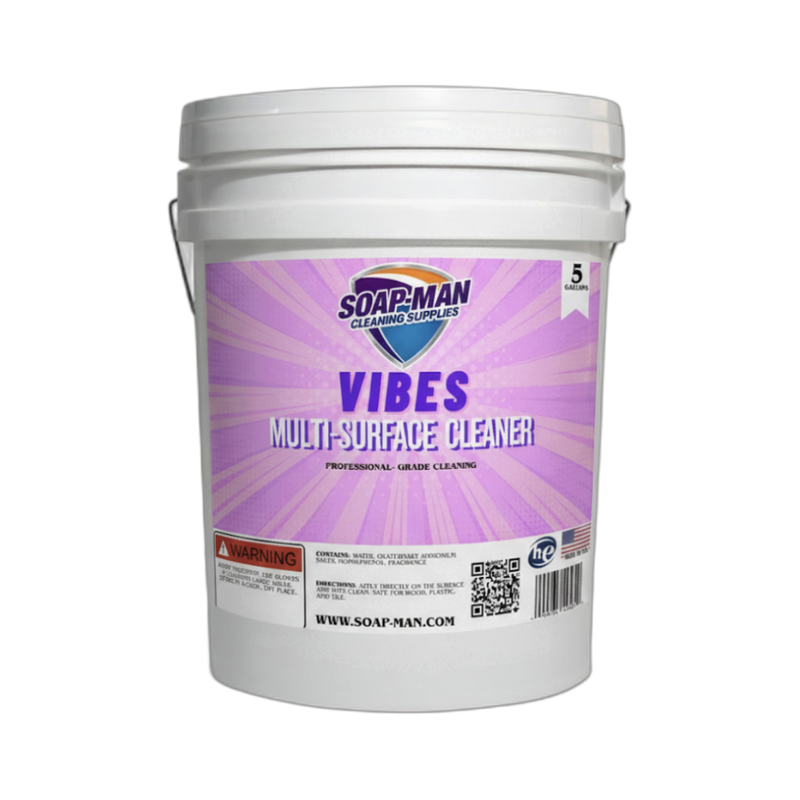
Vibes Multi-Surface Cleaner
Daily neutral-to-alkaline floor cleaner
pH 9-10 · 1:32 to 1:64 dilution · streak-free · safe on sealed floors
Daily damp-mop on VCT, sealed concrete, porcelain tile, terrazzo, laminate. Safe on sealed wood.
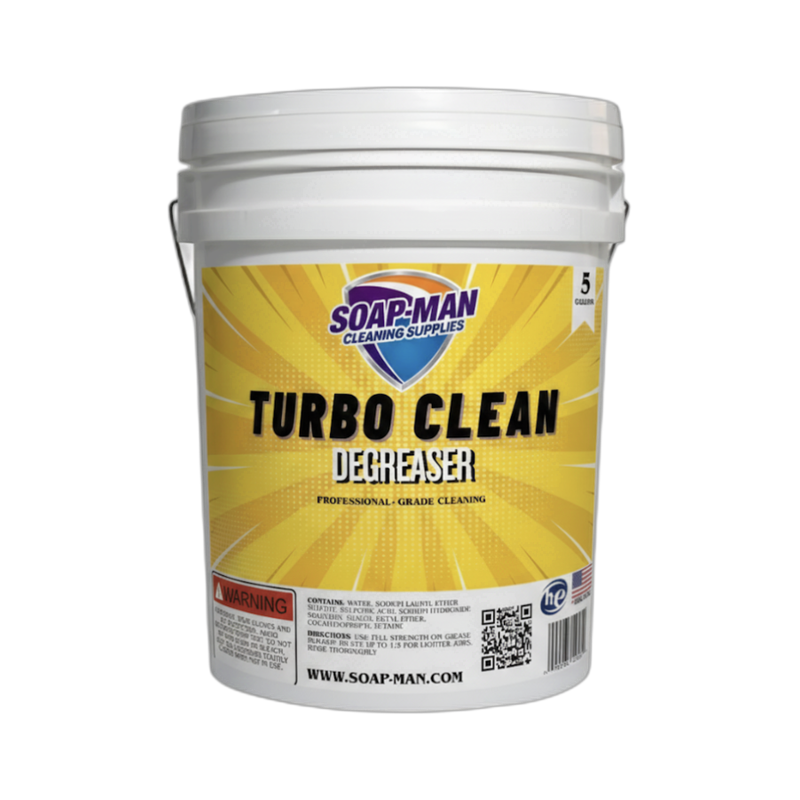
Turbo Clean Degreaser
Heavy alkaline floor degreaser / scrub
pH 12-13 · 1:10 to 1:50 dilution · food-service safe · non-flammable
Weekly/monthly auto-scrub on concrete, epoxy, quarry tile, kitchen floors. Strips wax — do not use on waxed or anodized substrates.
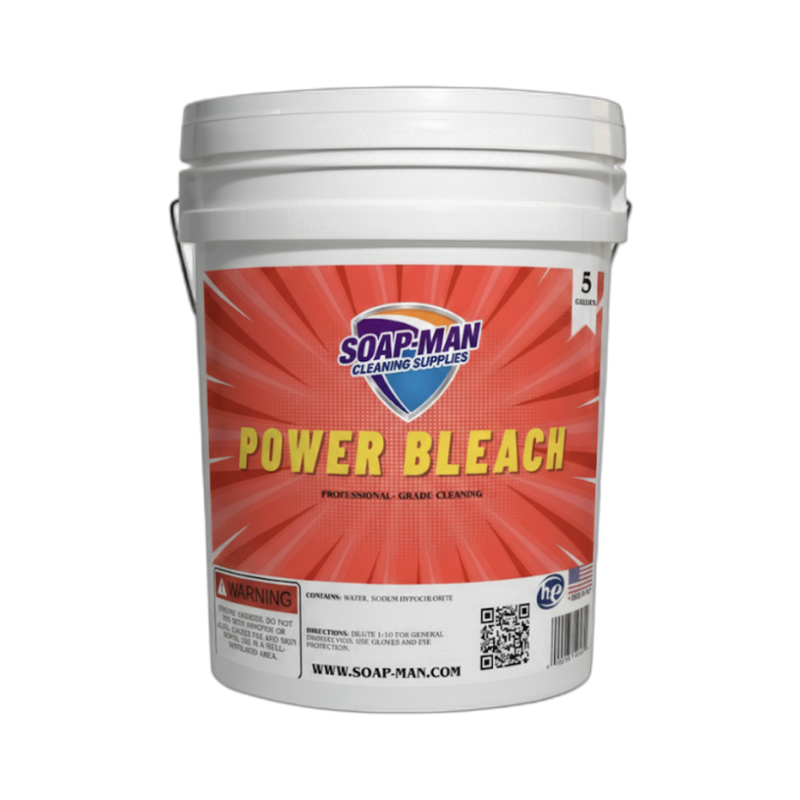
Power Bleach
Floor sanitizing / mold & mildew kill
12.5% NaOCl · pH 11.5-12.5 · dilute 1:10 for sanitation
Locker rooms, pool decks, grout lines, food-prep floors. Sanitize step after a neutral or alkaline clean — do not mix with acid or ammonia cleaners.
Six technical criteria for picking a commercial floor cleaner
Substrate chemistry, dilution control, dwell time, and slip safety — the specifics buying managers need before building a floor program.
Match pH to substrate
Sealed concrete, VCT, terrazzo, porcelain tile, laminate: pH 7-10 neutral cleaner (Vibes). Raw concrete, epoxy, quarry tile, unfinished warehouse floors: pH 11-13 alkaline cleaner (Turbo Clean). Never use pH 12+ on waxed or anodized floors — the caustic strips the finish and etches aluminum threshold strips.
Dilution ratio controls cost + performance
Vibes at 1:64 covers daily maintenance at ~$0.11/gallon of finished cleaner (5gal bucket basis). Turbo Clean at 1:50 hits ~$0.13/gallon finished for scrub cycles. Stronger dilutions (Turbo Clean at 1:10) reserved for spot grease or first-time wax strip — burns through bucket fast.
Know your scrubber's chemistry tolerance
Autoscrubbers with rubber squeegees tolerate pH 2-13. Solution tanks on most models are polyethylene (alkaline-safe). But pad-driven scrubbers using white or red pads are paired with neutral cleaner; black or brown strip pads are paired with alkaline stripper. Use the wrong pad and you waste chemistry.
Dwell time is as important as dilution
Turbo Clean degreaser needs 3-5 minutes of dwell on grease before scrubbing — rinsing too fast leaves petroleum residue embedded in the floor surface. Vibes works on contact at 1:32 for daily soil. Power Bleach sanitizer requires 5-minute contact time at 1:10 to achieve EPA-style kill claims.
Slip resistance after cleaning
Neutral cleaners (Vibes) leave no residual film when dosed correctly at 1:32-1:64. Over-dose at 1:16 and you get sticky residue that reduces slip coefficient below OSHA recommendations on wet floors. Rinse-free claims require strict dilution control.
Freight class and hazmat status
Vibes (pH 9-10) ships as Class 65 non-hazmat liquid. Turbo Clean (pH 12-13) ships as Class 65-70 corrosive liquid — palletized LTL, not parcel. Power Bleach ships under UN3082 packing group III, LTL pallet only. Plan pallet consolidation for mixed-SKU floor programs.
Floor chemistry spec comparison
pH, dilution range, compatible substrates, and substrates to avoid. Match chemistry to floor, not the other way around.
| Product | SKU | pH | Dilution | Compatible Substrates | Avoid | 5gal |
|---|---|---|---|---|---|---|
| Vibes Multi-Surface | SM-VB-001 | 9-10 | 1:32 to 1:64 | VCT, terrazzo, porcelain tile, sealed concrete, laminate, sealed wood | Bare aluminum, unfinished wood | $58 |
| Turbo Clean Degreaser | SM-TC-001 | 12-13 | 1:10 to 1:50 | Raw concrete, epoxy, quarry tile, stainless steel, painted steel | Waxed floors (strips wax), anodized aluminum, bare wood | $65 |
| Power Bleach (sanitize only) | SM-PB-001 | 11.5-12.5 | 1:10 for sanitation | Grout, tile, concrete after degrease step | Stainless steel (long contact), colored grout, natural stone | $58 |
Soap-Man floor program by environment
A stacked daily / deep / sanitize protocol for five common commercial environments. Replace the one-cleaner-for-everything approach with zone-specific chemistry.
| Environment | Daily cycle | Deep-scrub / weekly | Sanitize step |
|---|---|---|---|
| Commercial kitchen — quarry tile | Vibes 1:32 damp-mop | Turbo Clean 1:20 autoscrub + 3-min dwell | Power Bleach 1:10 contact 5 min, rinse |
| Retail / office — VCT | Vibes 1:64 damp-mop | Turbo Clean 1:50 autoscrub (quarterly) | Not typically required |
| Warehouse — sealed concrete | Vibes 1:32 autoscrub | Turbo Clean 1:10 for petroleum grease | Power Bleach 1:10 for biological spills only |
| Locker room / shower — porcelain tile + grout | Vibes 1:32 daily mop | Turbo Clean 1:20 weekly grout scrub | Power Bleach 1:10 weekly — 5 min dwell |
| Auto shop — bare concrete | Turbo Clean 1:50 push-mop oil drips | Turbo Clean 1:10 monthly autoscrub | Not required |
Call (908) 590-8562 to spec a custom floor program for your facility — we match SKU, dilution, and pallet volume to daily square-footage and zone type.
Commercial floor cleaner — technical FAQ
Seven operational questions from facility managers and cleaning contractors.
Spec your facility's floor program
Call and walk through your substrate mix, square footage, and soil load. We'll build a 3-SKU program matched to your floors with pallet pricing at 24+ units.