
Why Choosing the Right All-Purpose Cleaner Matters
As cleaning professionals, we see it constantly: people stockpiling six or seven specialty products when a single well-chosen all-purpose cleaner would handle most of the work. The right multi-surface cleaner saves you money, storage space, and time. The wrong one leaves streaks on your countertops, fails to cut grease on your stovetop, and smells like a chemical plant.
The all-purpose cleaner market in 2026 has changed significantly. Formulations have gotten stronger, concentrates have become the standard for commercial use, and eco-friendly options now actually perform. We spent months testing products across real-world conditions — not a lab, but actual kitchens, bathrooms, offices, and warehouses — to bring you picks that genuinely work.
Whether you manage a commercial facility, run a cleaning business, or simply want the best cleaner for your home, this guide breaks down what to look for, what to avoid, and which products earned a spot on our list.
What Makes a Great All-Purpose Cleaner
Before we get into specific products, it helps to understand what separates a mediocre all-purpose cleaner from a genuinely good one. Not all multi-surface formulas are created equal, and the label "all-purpose" can mean very different things depending on the manufacturer.
Cleaning Power vs. Surface Safety
The best all-purpose cleaners strike a balance between being strong enough to dissolve grease, soap scum, and everyday grime while remaining safe for a wide range of surfaces. A cleaner that eats through kitchen grease but damages your granite countertop is not truly all-purpose. Look for products with a pH between 8 and 11 — alkaline enough to cut through organic soils but not so caustic that they etch stone or strip finishes.
Concentration and Dilution Ratios
Commercial-grade cleaners almost always come as concentrates. This is a major advantage: you control the strength by adjusting the dilution ratio. A product with a 1:32 dilution for light cleaning and a 1:10 ratio for heavy degreasing gives you two cleaners in one bottle. Ready-to-use sprays are convenient for homeowners but far more expensive per use in a commercial setting.
Residue and Streak Performance
A cleaner that leaves a sticky or hazy residue defeats its own purpose. The best formulas evaporate cleanly or rinse away with minimal effort. This matters especially on glass, stainless steel, and dark countertops where residue is immediately visible. During our testing, residue performance was the single biggest differentiator between products that scored well and products that didn't.
Scent and Indoor Air Quality
Fragrance is personal, but what matters objectively is whether the cleaner's scent dissipates quickly and doesn't trigger reactions in sensitive individuals. Many commercial environments — healthcare, hospitality, schools — now require low-VOC or fragrance-free options. The best products offer a pleasant but not overpowering scent that fades within minutes of application.
Value Per Ounce
Price per bottle tells you nothing. Price per diluted ounce of working solution tells you everything. A $60 bucket of concentrate that makes 200 gallons of cleaning solution is dramatically cheaper per use than a $5 spray bottle that lasts a week. Always calculate your true cost per use when comparing products.
Our Top All-Purpose Cleaner Picks for 2026
We evaluated products across five categories: cleaning power, surface safety, residue performance, scent, and value. Here are the standouts.
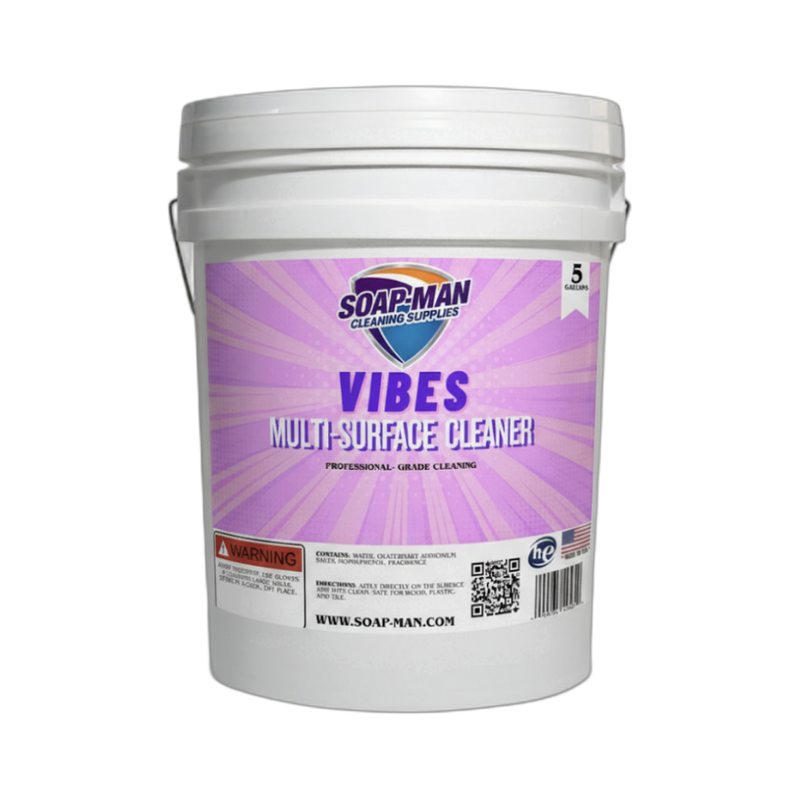
Best Overall: Soap-Man Vibes Multi-Surface Cleaner
Vibes earned the top spot for its combination of versatility, cleaning strength, and value. With a dilution range from 1:32 for daily maintenance up to 1:64 for light dusting, it handles everything from greasy kitchen counters to dusty office desks without leaving streaks or residue. The pH sits at 9.0-10.0, which is effective against organic soils while remaining safe for sealed stone, laminate, tile, glass, stainless steel, and painted surfaces.
What sets Vibes apart from competitors is the streak-free finish. On dark granite countertops and glass tabletops — surfaces that expose every flaw — it evaporated cleanly with no hazing. The Fresh Vibrance scent is noticeable during application but dissipates within five minutes. Available in both 1-gallon cases and 5-gallon buckets, the per-use cost for commercial operations is exceptionally low.
Best for: Offices, retail spaces, restaurants (front-of-house), hotels, residential cleaning services, and anyone who wants one cleaner that handles most daily surfaces.
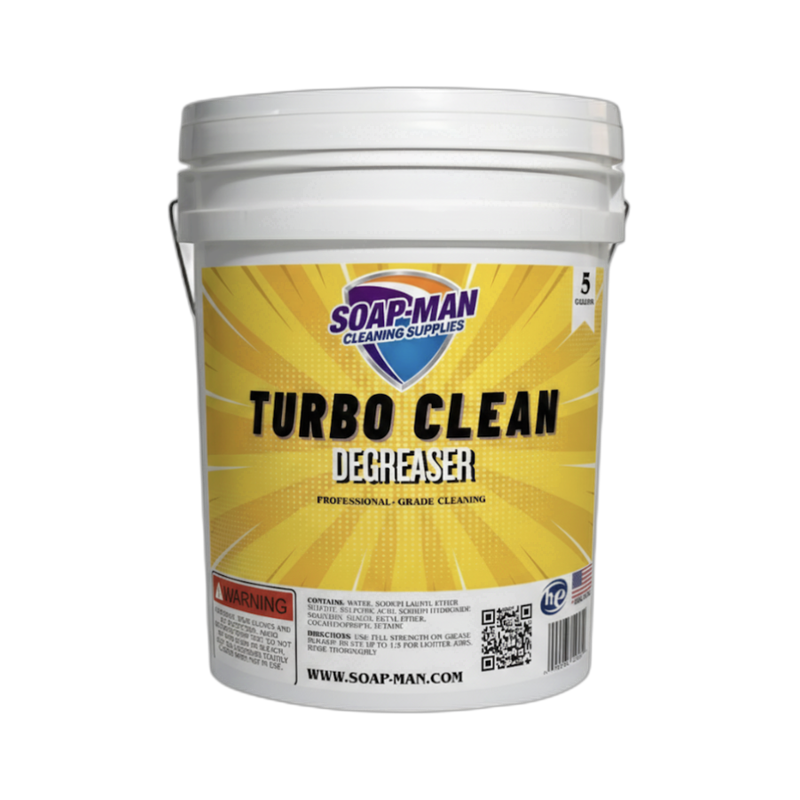
Best for Heavy Grease: Soap-Man Turbo Clean Degreaser
If your "all-purpose" needs include kitchen hoods, garage floors, or industrial equipment, you need something stronger than a standard multi-surface cleaner. Turbo Clean is formulated specifically for petroleum-based oils, cooking grease, and heavy industrial soils. At a 1:10 dilution for tough jobs or 1:50 for lighter grease, it offers the versatility of an all-purpose cleaner with the muscle of an industrial degreaser.
The pH of 12.0-13.0 means this is not for marble, natural stone, or delicate surfaces — it's built for metal, concrete, tile, and hard commercial surfaces. But for commercial kitchens, auto shops, manufacturing facilities, and warehouse floors, nothing else we tested came close to its degreasing speed. It's also food-service safe, which matters for restaurant and cafeteria use.
Best for: Commercial kitchens, auto repair shops, manufacturing floors, warehouses, and any environment with heavy grease or oil contamination.
Best Budget Option: Simple Green All-Purpose Cleaner
Simple Green has been a reliable budget option for decades, and the 2026 formulation continues that tradition. It's non-toxic, biodegradable, and effective on light to moderate cleaning tasks. The concentrate dilutes up to 1:30 for general cleaning. It won't match the performance of commercial-grade options on heavy grease, but for everyday household surfaces — countertops, appliances, floors, and bathroom fixtures — it gets the job done at a price that's hard to beat.
The main limitation is on tough soils. Where a product like Vibes cuts through dried splatters and moderate grease in a single pass, Simple Green often needs a second application or more dwell time. For the price-conscious homeowner who cleans regularly and doesn't face heavy-duty messes, that tradeoff is reasonable.
Best for: Budget-conscious households, light-duty commercial maintenance, and anyone who cleans frequently enough to prevent heavy buildup.
Best Eco-Friendly: Method All-Purpose Cleaner
For households and businesses that prioritize environmental impact, Method offers a plant-derived formula that's Cradle-to-Cradle certified and comes in 100% recycled plastic bottles. The cleaning performance on everyday surfaces — kitchen counters, bathroom sinks, dining tables — is genuinely good. It handles fresh spills and light grease without issue.
The limitations are predictable: it struggles with baked-on messes, heavy grease, and industrial soils. The fragrances (pink grapefruit, French lavender, and others) are polarizing — some people love them, others find them too strong. In a commercial setting, the cost per ounce makes it impractical. But for an eco-conscious home where daily maintenance cleaning is the primary need, it's a solid performer.
Best for: Eco-conscious households, small offices with green cleaning policies, and light-duty everyday cleaning.
Best for Glass and Mirrors: Soap-Man Streak Free Glass Cleaner
Technically a specialty cleaner, Streak Free earns a spot here because so many people use their all-purpose cleaner on glass and are disappointed by the streaks. If windows, mirrors, and glass surfaces are a significant part of your cleaning routine, having a dedicated glass cleaner makes a real difference. The ammonia-free formula dries without any streaking or hazing, and it's safe for tinted windows and anti-reflective coatings — things most all-purpose cleaners can damage over time.
Use it alongside a true all-purpose cleaner for the best results across your facility. Vibes handles the counters, desks, and hard surfaces while Streak Free handles every piece of glass in the building.
Best for: Office buildings, hotels, retail storefronts, restaurants, and any facility with significant glass or mirror surfaces.
How to Choose the Right All-Purpose Cleaner
With so many options available, the decision comes down to matching the product to your actual cleaning demands. Here's a decision framework we use with our commercial clients.
Assess Your Primary Surfaces
List the surfaces you clean most frequently. If it's mostly sealed hard surfaces — countertops, tile, laminate, painted walls — a standard multi-surface cleaner like Vibes is your best bet. If grease is a daily challenge, you need a degreaser that doubles as an all-purpose option, like Turbo Clean at a higher dilution ratio.
Evaluate Your Soil Level
A residential kitchen that gets wiped down daily has very different needs than a commercial kitchen that runs a fryer for 12 hours straight. Light-duty cleaners work beautifully when used regularly on moderate soils. Heavy-duty environments need a product formulated for the toughest jobs, then diluted lighter for daily maintenance.
Calculate Your True Cost
Here's a quick comparison to illustrate the difference in value:
- Ready-to-use spray bottle (32 oz): $4-$6, gives you 32 oz of solution. Cost per ounce: $0.13-$0.19.
- Concentrate gallon (1:32 dilution): $15-$20, makes approximately 33 gallons (4,224 oz) of solution. Cost per ounce: $0.004-$0.005.
- 5-gallon bucket (1:32 dilution): $55-$65, makes approximately 165 gallons (21,120 oz) of solution. Cost per ounce: $0.003.
The math is straightforward. Concentrates deliver 30-50 times more cleaning solution per dollar than ready-to-use products. For any commercial operation or cleaning-intensive household, concentrates are the only choice that makes financial sense.
Consider Your Environment
Healthcare and childcare facilities need disinfecting capabilities. Food service operations need food-safe formulas. Hotels need products that are effective but won't leave strong scents in guest rooms. Schools and office buildings may have air quality policies that restrict certain chemicals. Match the product to the regulatory and practical requirements of your space.
Common All-Purpose Cleaner Mistakes
In our years of working with commercial cleaning clients, we see the same mistakes repeated constantly. Avoiding these will save you time, money, and damaged surfaces.
Using the Same Dilution for Everything
If your concentrate calls for 1:32 dilution for general cleaning and 1:10 for heavy degreasing, use the right ratio for the job. Using full strength on light tasks wastes product and can leave residue. Using a weak dilution on heavy grease means you'll re-clean the same surface twice.
Spraying and Immediately Wiping
Almost every cleaner needs dwell time — the seconds or minutes the solution sits on the surface breaking down soils. For light messes, 15-30 seconds is usually sufficient. For moderate grime, give it a full minute. For tough, baked-on messes, 3-5 minutes of dwell time makes the difference between scrubbing and simply wiping clean.
Using All-Purpose Cleaner on Natural Stone
Unsealed marble, granite, limestone, and travertine are sensitive to alkaline cleaners. Even a pH of 9.0 can etch or dull natural stone over time. If you have natural stone surfaces, use a pH-neutral cleaner specifically designed for stone. Your all-purpose cleaner should handle everything else while you keep a separate stone-safe product for those surfaces.
Ignoring the Microfiber
The cloth matters as much as the cleaner. A good microfiber cloth traps dirt and absorbs moisture efficiently, preventing streaks and reducing the amount of product you need. Cheap paper towels or cotton rags redistribute dirt and leave lint behind. Invest in quality microfiber and wash them properly — no fabric softener, which coats the fibers and reduces their effectiveness.
Mixing Cleaners
Never combine cleaning products unless the manufacturer explicitly says it's safe. Mixing bleach with ammonia-based products creates toxic chloramine gas. Mixing bleach with acidic cleaners creates chlorine gas. Mixing hydrogen peroxide with vinegar creates peracetic acid. Even combinations that aren't immediately dangerous can reduce the effectiveness of both products. Use one product at a time, rinse between products, and let the chemistry do its job.
Pro Tips for Getting the Most from Your All-Purpose Cleaner
These are the practices we recommend to every client, from single-location restaurants to multi-building facility management companies.
Set Up a Dilution Station
For commercial operations, install a proportioning dispenser at your utility sink. It automatically mixes the correct ratio every time, eliminates waste from over-pouring, and ensures consistent cleaning performance across your entire staff. The initial investment pays for itself in product savings within weeks.
Label Everything
Secondary containers — your spray bottles and buckets — must be labeled with the product name and dilution ratio. This is an OSHA requirement for commercial facilities and a common-sense practice at home. It prevents accidental mixing, ensures consistency, and makes training new staff easier.
Clean from Top to Bottom
Start with the highest surfaces and work down. Dust and drips fall, so cleaning countertops before the floor means you won't dirty the floor you already cleaned. In kitchens: range hood first, then backsplash, then counters, then cabinet faces, then floor.
Use the Two-Cloth Method
Spray the surface with your all-purpose cleaner. Wipe with Cloth 1 (the "cleaning" cloth) to lift dirt. Immediately follow with Cloth 2 (the "drying" cloth) to buff dry and prevent streaks. This two-pass method delivers visibly better results on countertops, stainless steel, and any surface where appearance matters.
Rotate Your Microfiber
Fold your microfiber cloth into quarters. You now have eight clean surfaces (four on each side). When one section gets soiled, refold to expose a clean face. This keeps you cleaning with a fresh surface without constantly grabbing new cloths.
All-Purpose Cleaner Comparison Chart
Here's a side-by-side summary of our top picks to help you decide:
- Vibes Multi-Surface Cleaner: pH 9.0-10.0 | Dilution 1:32-1:64 | Streak-free | Best overall versatility | Commercial and residential
- Turbo Clean Degreaser: pH 12.0-13.0 | Dilution 1:10-1:50 | Heavy grease specialist | Best for kitchens and industrial | Food-service safe
- Simple Green: pH 8.5-9.5 | Dilution 1:30 | Non-toxic, biodegradable | Best budget option | Light to moderate soils
- Method: pH 7.0-8.0 | Ready-to-use | Plant-derived, Cradle-to-Cradle certified | Best eco-friendly | Light daily cleaning
- Streak Free Glass Cleaner: pH 10.0-11.0 | Ready-to-use or 1:4 | Ammonia-free, tint-safe | Best for glass and mirrors | Commercial buildings
Frequently Asked Questions
Can I use an all-purpose cleaner on wood floors?
Only if the product specifically lists hardwood as a safe surface and you use the most diluted ratio available. Most all-purpose cleaners are too alkaline for wood finishes and will dull the surface over time. For regular hardwood floor maintenance, use a pH-neutral cleaner formulated for wood. For occasional spot cleaning of a sticky spill on hardwood, a well-diluted all-purpose cleaner applied sparingly and dried immediately is acceptable.
Is it safe to use all-purpose cleaner around pets?
Most commercial all-purpose cleaners are safe once dried. The concern is during application when the product is wet and the area is being ventilated. Keep pets out of the room during cleaning and ensure the surface is dry before allowing them back. For households with pets that frequently contact cleaned surfaces — cats on countertops, dogs on tile floors — consider a plant-based or fragrance-free formula and always rinse the surface after cleaning.
How often should I replace my all-purpose cleaner?
Concentrates have a long shelf life — typically 1-2 years unopened and 6-12 months once opened, depending on the product. Diluted solutions in spray bottles should be remade weekly in commercial settings and every two weeks at home. Over time, diluted solutions lose effectiveness as the active ingredients degrade. Don't make more solution than you'll use in a week.
Can all-purpose cleaner replace my bathroom cleaner?
For daily bathroom maintenance — wiping counters, spot-cleaning mirrors, cleaning the outside of the toilet — yes. For deep cleaning tasks like removing hard water deposits, soap scum buildup, or mold and mildew, you'll likely need a specialized bathroom cleaner with acid or bleach components. An all-purpose cleaner can reduce how often you need the heavy-duty products, but it won't replace them entirely.
What's the difference between a cleaner and a disinfectant?
A cleaner removes visible dirt, grease, and grime from surfaces. A disinfectant kills bacteria and viruses. Most all-purpose cleaners are cleaners, not disinfectants. Some products are marketed as cleaner-disinfectant combinations, but these usually require a specific dwell time (often 5-10 minutes of wet contact) to achieve disinfection. If you need actual disinfection — food prep surfaces, healthcare environments, bathrooms — check the product label for EPA registration and follow the dwell time instructions exactly.
Is a more expensive all-purpose cleaner actually better?
Price per bottle is misleading. Compare price per ounce of diluted solution. A $60 bucket that makes 160+ gallons of working solution costs far less per use than a $5 spray bottle. Among products at comparable diluted costs, quality differences come down to streak performance, grease-cutting power, and surface safety. Expensive does not automatically mean better, but the cheapest option almost always involves trade-offs in cleaning power or residue performance.
Can I use all-purpose cleaner in a steam cleaner?
No, unless the product and the machine both explicitly say it's compatible. Most steam cleaners are designed to work with water only or with specific steam-compatible solutions. Adding a standard all-purpose cleaner to a steam cleaner can damage the machine's seals and internal components, void the warranty, and produce excessive foam that impairs performance. Check your machine's manual first.