
Why Your Degreaser Choice Matters
Commercial kitchens generate volumes of grease that residential products simply cannot handle. A 10-gallon fryer at a high-volume restaurant accumulates more baked-on grease in a single day than most home kitchens produce in a month. When you try to clean that with a consumer degreaser, you end up using three times the product, scrubbing twice as long, and still leaving residue that a health inspector will flag.
Commercial-grade degreasers are formulated specifically for this environment. They work faster, at higher concentrations, on hotter surfaces, and with less mechanical effort. But they also come in several different chemistries, each with strengths and limitations. Buying the wrong type is an expensive mistake. This guide explains the three main categories, when to use each, and what a professional buyer checks before committing to a supplier.
What You'll Need
- A clear picture of your cleaning tasks — fryers, grills, exhaust hoods, floors, walls, each have different degreaser needs.
- Equipment material information — stainless steel, aluminum, cast iron, anodized surfaces each tolerate different chemistries.
- A spray bottle, foamer, or dilution station — application matters as much as product selection.
- Appropriate PPE — gloves, eye protection, and proper ventilation.
- A test method — test strips for alkalinity, or timed trials on a single station to compare products.
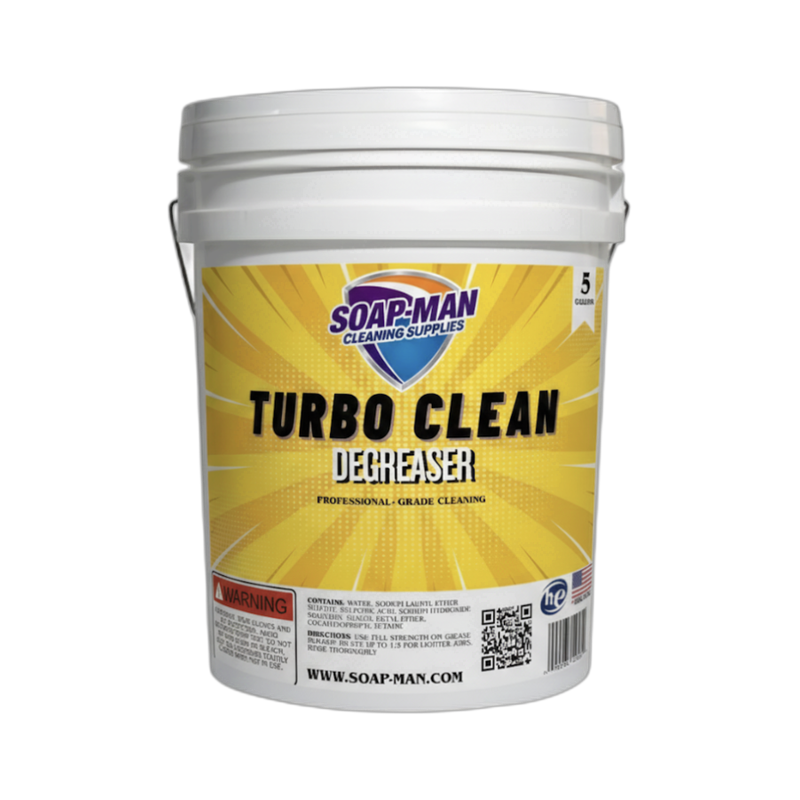
- A reliable supplier — Soap-Man Turbo Clean Degreaser is built for daily commercial kitchen use.
The Three Main Types of Commercial Degreasers
1. Alkaline Degreasers (Caustic-Based)
Alkaline degreasers use sodium hydroxide (lye), potassium hydroxide, or sodium metasilicate as active ingredients. They're the workhorses of commercial kitchens because they saponify fats — turning grease into soap that rinses away with water.
Best for: Fryers, grills, ovens, exhaust hoods, floors, and any surface with baked-on grease. The standard choice for restaurant kitchens.
Strengths: Fast-acting, extremely effective on heavy grease, economical when purchased as a concentrate.
Limitations: Can damage aluminum, galvanized metal, and some anodized surfaces. Not safe for food-contact surfaces without thorough rinsing.
What to look for: A product formulated specifically for hot-surface use, with a dilution chart covering light, medium, and heavy-duty applications. Turbo Clean Degreaser falls in this category and is engineered for the full range of commercial kitchen tasks.
2. Solvent-Based Degreasers
Solvent degreasers use petroleum distillates, citrus terpenes, or glycol ethers to dissolve grease. They're most commonly used on specific industrial tasks rather than general kitchen cleaning.
Best for: Specific spot cleaning on machinery, grease trap maintenance, certain floor preparation tasks.
Strengths: Effective on grease that's dried or hardened, can work on cold surfaces, doesn't require rinsing in some applications.
Limitations: More expensive than alkaline products, can leave residue, may have flammability concerns, potential worker health exposure with repeated use.
3. Enzyme-Based Degreasers
Enzyme degreasers use biological enzymes and bacteria to break down organic fats and oils. They work slowly but continue working for hours after application.
Best for: Floor drains, grease traps, ongoing maintenance of drains and lift stations.
Strengths: Continue working after application, environmentally friendly, safe on most surfaces, reduce downstream grease buildup in drains.
Limitations: Slow compared to alkaline products, ineffective on heavy baked-on grease, require specific temperature ranges to work properly.
How to Choose the Right Degreaser for Your Kitchen
Step 1: Map Your Cleaning Tasks
List every surface that needs regular degreasing and the type of grease buildup on each one. Fryers and grills are hot-surface, heavy-duty jobs. Floors are cold-surface, moderate-duty. Exhaust hoods are heavy-duty but often awkward positions.
Step 2: Match Chemistry to Tasks
For a standard restaurant kitchen, an alkaline degreaser handles 90% of your cleaning needs. For floor drains and grease traps, add an enzyme product. Solvent degreasers are rarely needed for general food service.
Step 3: Evaluate Dilution Ratios
A concentrated degreaser that dilutes 1:20 or 1:30 for daily use is more economical than a ready-to-use product over time. Check the label for the dilution chart and compare the cost per diluted gallon, not the cost per bottle.
Step 4: Test on a Single Station First
Before committing to a large order, test the product on one station for a week. Check cleaning speed, effectiveness on stubborn spots, product consumption, and any damage to equipment.
Step 5: Confirm Food Safety Compliance
For surfaces that contact food, the product should be labeled as safe for food-contact surfaces when rinsed or (if no-rinse formulation) labeled as food-contact safe at the specified dilution.
Pro Tips
- Buy concentrates, not ready-to-use. Concentrated degreaser at 1:20 dilution is dramatically cheaper than RTU product per application.
- Apply degreaser to hot surfaces. Warmth helps the product penetrate and saponify grease. Let cold equipment warm slightly before applying.
- Allow dwell time. Alkaline degreasers need 3-5 minutes of contact time to break down baked grease. Spraying and immediately scrubbing wastes product and time.
- Use a foamer for vertical surfaces. Foamed degreaser clings to exhaust hoods and walls instead of running off.
- Rinse thoroughly on food-contact surfaces. Alkaline residue is not food-safe even when the underlying surface looks clean.
- Store degreasers in their original containers. Transferring concentrates to mislabeled bottles is a common cause of workplace chemical exposure.
Common Mistakes
- Using the wrong dilution. Too concentrated damages equipment. Too diluted doesn't clean. Follow the chart.
- Buying based on sticker price, not cost per use. A $30 concentrate that makes 30 gallons is cheaper than a $12 RTU gallon.
- Ignoring material compatibility. Caustic degreasers eat aluminum and damage some coated metals.
- Skipping the rinse. Alkaline residue on food-contact surfaces fails health inspections.
- Mixing degreaser with other products. Caustics react unpredictably with acids and some surfactants.
- Using cold water for hot-greasy tasks. Warm water helps alkaline products work faster and more effectively.
- Not training staff on proper application. Dwell time and dilution knowledge are what separate effective use from wasted product.
FAQ
What's the difference between a degreaser and an all-purpose cleaner?
All-purpose cleaners are formulated for general soil removal on typical household surfaces. Degreasers are formulated specifically to break down fats and oils, and they operate at higher alkalinity or with specialized solvents. You need both in a commercial kitchen — one won't substitute for the other.
Can I use a degreaser on stainless steel?
Yes, most commercial alkaline degreasers are safe for stainless steel when used at proper dilution. However, prolonged contact with highly concentrated caustic products can dull the finish over time. Rinse thoroughly after use.
How do I know if a degreaser is safe for my aluminum equipment?
Check the label specifically. Most high-alkaline degreasers will damage aluminum on prolonged contact, causing darkening, pitting, or etching. For aluminum equipment, look for degreasers specifically labeled as aluminum-safe, or use a mild detergent instead.
Is citrus-based degreaser as effective as traditional alkaline products?
Citrus degreasers work well on light to moderate grease and are often promoted as environmentally friendly. However, for heavy-duty restaurant kitchen tasks — fryers, grills, exhaust hoods — alkaline products like Turbo Clean Degreaser are significantly more effective and more economical per use.
How often should I deep-degrease my fryer?
At minimum, a full fryer degrease once per week with oil changes. High-volume operations may need twice-weekly deep cleans. Daily wipe-downs with diluted degreaser between deep cleans prevent baked-on buildup and extend the time between heavy cleanings.