
Most facility managers comparing cleaning supplies look at the gallon price and pick the cheaper one. That comparison is wrong. The metric that determines whether you actually saved money is cost per diluted ounce — the price of the working solution that comes out of the spray bottle, not the price of the container on the shelf. By cost per diluted ounce, retail spray bottles are 5x to 60x more expensive than commercial concentrates. This article shows the math, the variables that matter, and the realistic savings curves for typical facility sizes.
Why the Gallon Comparison Is Misleading
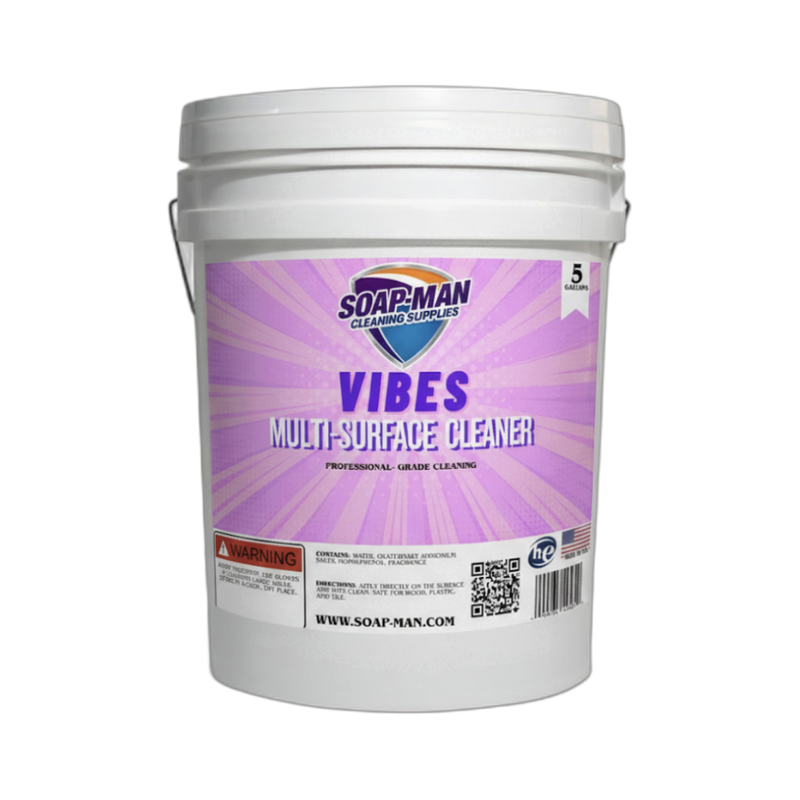
A retail spray bottle of all-purpose cleaner costs roughly $4 for 32 oz — that is roughly $16 per gallon equivalent. A commercial concentrate like Vibes Multi-Surface Cleaner costs roughly $58 per 5-gallon bucket — that is $11.60 per gallon. At first glance, the concentrate looks 30 percent cheaper. But the comparison is unfair, because:
- The retail bottle contains roughly 95 percent water by weight and is sold ready-to-use.
- The concentrate contains roughly 70 to 90 percent active surfactants and dilutes 1:32 to 1:64 with water at the point of use.
One gallon of concentrate at 1:32 dilution produces 33 gallons of working solution. At 1:64, it produces 65 gallons. So the relevant comparison is 1 gallon of retail product (gives 1 gallon of working solution) vs. 1 gallon of concentrate (gives 33 to 65 gallons of working solution).
The Cost-Per-Diluted-Ounce Math
Doing the calculation properly:
- Retail spray bottle: $4 per 32 oz = $0.125 per oz of working solution
- Commercial concentrate at 1:32: $11.60 per gallon ÷ (33 gallons × 128 oz) = $0.0027 per oz of working solution
- Commercial concentrate at 1:64: $11.60 per gallon ÷ (65 gallons × 128 oz) = $0.0014 per oz of working solution
That is a 46x to 89x cost-per-ounce gap in favor of concentrate. For a 10,000 sqft facility that uses roughly 4 oz of working solution per 1,000 sqft cleaned daily, that comes out to:
- Retail: 40 oz per day × $0.125 = $5.00/day = $1,825/year on multi-surface cleaner alone
- Concentrate at 1:32: 40 oz per day × $0.0027 = $0.11/day = $40/year on multi-surface cleaner alone
For one product category in one mid-sized facility, that is $1,785 in annual savings. Roll that across 5 chemical categories and you are typically looking at $5,000 to $12,000 in annual savings for facilities in the 10,000 to 25,000 sqft range — without changing cleaning quality at all.
What "Bulk" Actually Buys You
The "bulk" portion of bulk-cleaning-supply pricing is layered. The biggest savings come from concentrate-vs-ready-to-use (the math above). On top of that, two more savings tiers stack:
Tier 1: Concentrate (the chemistry win)
This is the 5x-to-60x gap above. It is structural and applies to every concentrate product against every retail equivalent.
Tier 2: Volume Pricing (the unit-count win)
Most commercial suppliers, including Soap-Man, offer volume pricing that kicks in at 6 units, 12 units, and pallet (typically 24 units). The discount per tier typically runs 5 to 15 percent, with 30 to 40 percent at pallet. For a facility that orders monthly, hitting the 6-unit tier on a single order is straightforward — buy two cases of the daily-use product, two cases of degreaser, and two cases of paper towels in the same order.
Tier 3: Recurring Delivery (the operational win)
This is the lever most managers underuse. A recurring delivery program (monthly or quarterly) eliminates the emergency-restock problem. Emergency restocks force a facility to either run out (unacceptable) or buy retail at the local hardware store at full retail prices. Even one emergency retail run per month at $50 over normal cost adds $600 per year — typically more than enough to fund the volume-tier discount on a properly sized recurring order.
The Hidden Variable: Labor Cost
Cleaning supply spend is roughly 10 to 20 percent of a facility's total cleaning budget. Labor is roughly 70 to 85 percent. According to BLS Occupational Employment and Wage Statistics May 2024, the mean hourly wage for Janitors and Cleaners (SOC 37-2011) was $17.99 per hour — and that excludes payroll taxes, benefits, and supervision overhead, which typically push fully-loaded labor costs to $22 to $28 per hour.
Why this matters for bulk supply ROI: cheaper supplies that work less effectively can quietly increase labor cost. A retail glass cleaner that streaks forces a second pass — which is 50 percent more labor on the glass-cleaning task. A retail degreaser that requires 2x the volume to cut through grease consumes more product AND more labor. The most expensive scenario is a "cheap" supply that doubles labor: at $22/hour fully loaded, an extra 30 minutes per day across a 4-person crew costs $44 per day, or roughly $11,400 per year — enough to buy commercial concentrates for a year and still have $7,000 left over.
The cleaning supply cost calculator models both supply and labor cost using ISSA Official Cleaning Times production rates and BLS wage data. Run your facility through it before any supply contract negotiation.
When Bulk Doesn't Save You Money
Bulk supply economics break down in three scenarios:
- Very small facilities (under 1,500 sqft). A 5-gallon bucket of concentrate at 1:64 dilution produces 325 gallons of working solution. At 4 oz per 1,000 sqft cleaned daily, a 1,500 sqft facility uses roughly 6 oz per day, or 12 ounces per cleaning shift. That is 2,200 cleaning shifts per bucket — over 6 years for a 5-day-per-week schedule. Concentrates have a 12 to 24 month shelf life once opened. The bucket will expire before you finish it. For very small facilities, case-quantity (4 gallons) is the right unit.
- Specialty products with low usage. Glass cleaner, oven cleaner, and wood cleaner are typically used 5 to 20 percent as often as multi-surface or degreaser. Buying these in 5-gallon buckets often does not match a facility's actual usage cadence. Stick with case quantities.
- No on-site dilution capability. Concentrates require either a chemical dispenser (wall-mounted dilution station) or a worker who knows how to mix at the right ratio with the right water and the right container. A facility with no trained operator and no dispenser will end up with mis-diluted product (too strong damages surfaces, too weak fails to clean) and the cost-per-ounce advantage disappears. Investment in a dispenser ($150-$400) usually pays back within 3 to 6 months.
How to Calculate Your Own ROI
Five-step calculation:
- Pull current annual cleaning supply spend. Look at the last 12 months of invoices and total it by category (multi-surface, degreaser, glass, disinfectant, paper, trash liners).
- Identify which categories are being bought at retail or ready-to-use. Anything in a spray bottle is ready-to-use. Anything labeled "concentrate" or sold in 5-gallon buckets is bulk.
- For each ready-to-use category, calculate the equivalent commercial concentrate cost. Take the gallon-equivalent retail price and divide by 33 (approximate 1:32 yield ratio). That is the apples-to-apples cost.
- Sum the savings. Retail cost minus concentrate cost equals the structural saving from switching.
- Add the volume tier discount. If your annualized order volume hits the 6-unit or 12-unit tier with the new supplier, add 5 to 15 percent on top of the structural saving.
For most facilities making the switch from a mix of retail and commercial supplies to a fully commercial concentrate program, total savings run 30 to 50 percent of current cleaning supply spend. Larger facilities (above 25,000 sqft) typically see closer to 40 to 50 percent. Smaller facilities (5,000 to 15,000 sqft) closer to 30 to 40 percent.
Soap-Man Volume Pricing
Soap-Man's volume pricing tiers are public and apply to all customers — no negotiation required, no minimum contract. Discounts kick in at:
- 6 units — typically 5-10% off case prices
- 12 units — typically 10-15% off case prices
- Pallet (24+ units) — typically 25-40% off case prices, contact-only quote
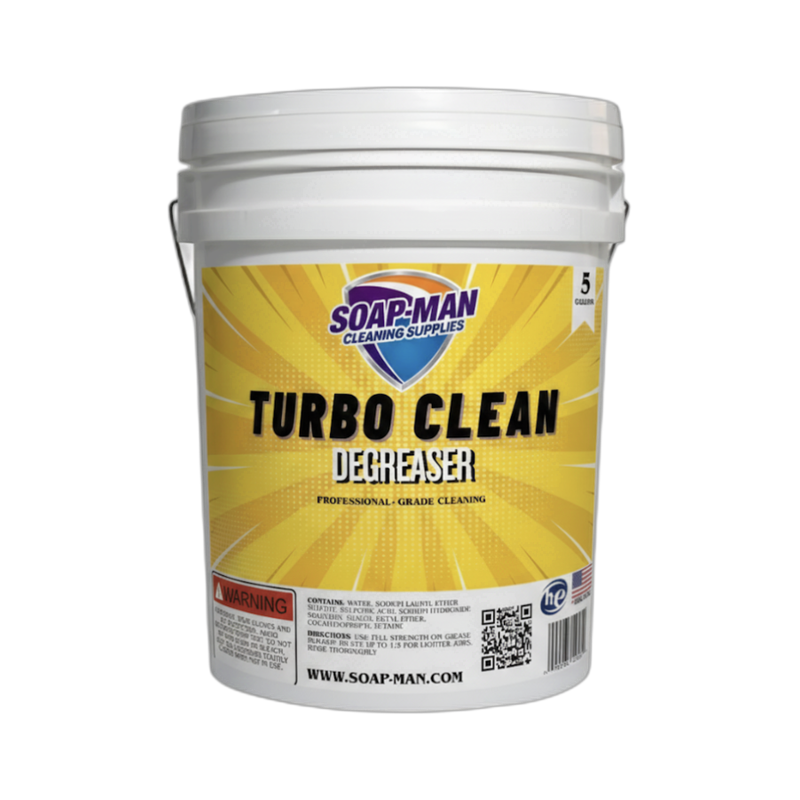
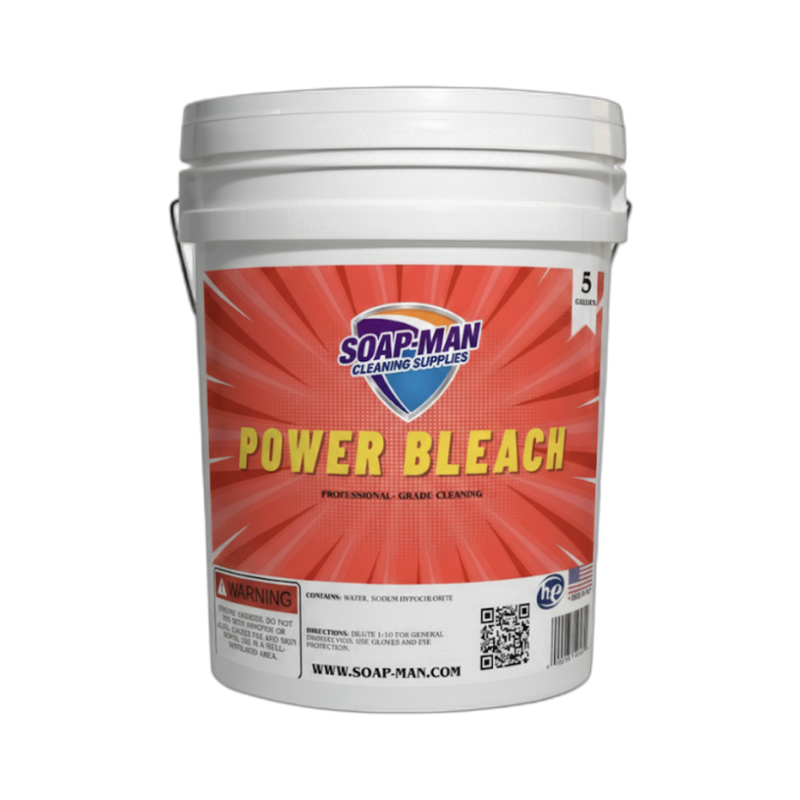
Free delivery applies to orders over $500 across the East Coast (NJ, NY, PA, MD, DE, CT, VA, MA, RI, DC). Stripe-secured online checkout for case and bucket quantities; pallet orders go through a quote at /quote or (908) 590-8562. The whole catalog is at /products, and the daily-workhorse products are Vibes Multi-Surface Cleaner, Turbo Clean Degreaser, and Power Bleach. The commercial cleaning hub walks through how to build a balanced program.
Frequently Asked Questions
How much money does a typical office save switching to bulk cleaning supplies?
For a 5,000 to 15,000 sqft office buying retail or mixed supplies today, expect 30 to 50 percent reduction in annual cleaning supply spend after switching to a commercial concentrate program with volume pricing. In dollar terms, that typically runs $1,500 to $6,000 per year for offices in this size range. Restaurants, healthcare, and warehouses see proportionally larger absolute savings because supply spend is higher to start with.
Do I need a chemical dispenser to use concentrates?
Strongly recommended for facilities above 5,000 sqft. A wall-mounted dispenser ($150 to $400 typically) automatically dilutes concentrate at the correct ratio into a spray bottle or mop bucket. Without a dispenser, operators measure with a measuring cup, which is slower, more error-prone (under-dilution wastes product, over-dilution fails to clean), and harder to standardize across shifts. Most commercial suppliers, including Soap-Man, can recommend dispenser configurations for the products you order.
How long do commercial concentrates last in storage?
Most commercial concentrates have a 12 to 24 month shelf life unopened. Once opened, exposure to air starts gradual degradation — typically 6 to 12 months of usable life. Bleach products degrade faster than quat or surfactant-based products. Store in a cool dry place out of direct sunlight, with caps fully tightened. OSHA HazCom 1910.1200 requires that all chemical storage have legible labels and accessible Safety Data Sheets.
Is bulk cleaning supply cheaper than retail in every category?
Concentrate-vs-ready-to-use chemistry is cheaper in every category where a concentrate exists (multi-surface, degreaser, glass, disinfectant, floor cleaner, dish soap). For products that are not typically sold as concentrates (toilet paper, paper towels, trash liners), bulk savings come purely from volume pricing rather than dilution. Volume savings on paper and consumables typically run 15 to 30 percent at case quantity vs. retail-pack pricing.
What's the minimum order to get free delivery?
Soap-Man offers free delivery on orders over $500 across the East Coast service area. Below $500, standard freight charges apply. For most facilities, a single monthly order easily clears $500 once you bundle chemicals, paper, and trash liners.
Can I buy a single gallon to test before committing to a case?
Soap-Man's minimum order is a 4-gallon case for chemicals (no single-gallon retail-style purchases). However, the volume pricing tiers do not require committing to recurring delivery — a single 4-gallon case purchase is fine for testing the product fit. Most facilities go through a single case in 1 to 3 months and can evaluate before placing the next order.
Does buying bulk affect the chemical's effectiveness?
No — concentrate is the same chemistry as ready-to-use, just without the water. When properly diluted at the point of use, the working solution is identical to the retail version (and often stronger, because retail formulations are sometimes diluted further to reduce cost or shipping weight). The single condition is correct dilution, which is why we recommend a dispenser for any facility above 5,000 sqft.
How do I justify the upfront order cost to my CFO?
Three numbers: current annual supply spend, projected supply spend on commercial concentrates, and the difference. For most mid-sized facilities, the annualized savings ($1,500 to $6,000) cover the upfront concentrate order and a dispenser within 30 to 60 days. The cleaning supply cost calculator produces a side-by-side comparison you can paste into a finance memo. Or call (908) 590-8562 and we will run the numbers on your specific facility.