
Why Driveways Need Pressure Washing
Driveways take more abuse than any other surface around your home. Vehicle traffic, oil drips, tire marks, tree sap, algae growth, mold, mildew, and years of accumulated dirt combine to turn once-clean concrete into a dark, stained surface that drags down the entire appearance of a property.
Regular garden-hose cleaning barely dents this buildup. The water pressure from a typical garden hose is about 40-60 PSI. A pressure washer delivers 1,500-4,000 PSI — enough force to strip away years of embedded grime, oil stains, and biological growth in a single pass. Done correctly, pressure washing makes a driveway look nearly new. Done incorrectly, it can etch the surface, create visible lines, and damage surrounding landscaping.
This guide covers everything: choosing the right equipment, pre-treating stains, proper technique, and the post-wash steps that protect your driveway for the long term.
What You'll Need
Having the right equipment set up before you start prevents interruptions and ensures consistent results across the entire driveway.
- Pressure washer (2,500-3,000 PSI minimum) — Gas-powered pressure washers deliver consistent power for large surfaces. Electric models work for smaller driveways but may struggle with heavy staining. Rent a commercial unit from a home improvement store if you don't own one.
- Surface cleaner attachment — This disc-shaped attachment contains two spinning nozzles under a shroud. It cleans evenly across a 12-15 inch swath without leaving the tiger stripes that a single nozzle creates. This is the single most important accessory for driveway cleaning.
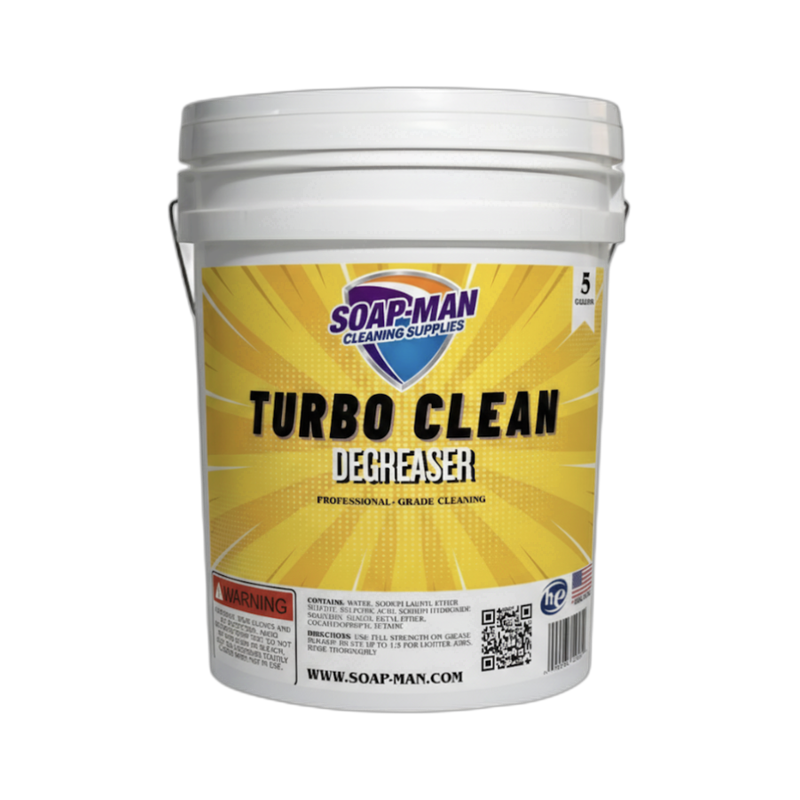
- Degreaser — Turbo Clean Degreaser for pre-treating oil stains, tire marks, and heavy grease spots. Its industrial-strength formula dissolves petroleum-based contamination that pressure washing alone won't fully remove.
- Nozzle set — 25-degree (green) for general cleaning, 15-degree (yellow) for stubborn spots, 40-degree (white) for soap application. Never use the 0-degree (red) nozzle on concrete — it etches and damages the surface.
- Stiff broom — For scrubbing pre-treated stains before pressure washing.
- Safety gear — Closed-toe shoes (pressure washers can cause serious injury to bare feet), safety glasses, and hearing protection for gas-powered units.
- Garden hose with adequate water supply — Pressure washers need consistent water flow. Make sure your hose and spigot deliver enough GPM (gallons per minute) to feed the washer — running a pressure washer with insufficient water supply damages the pump.
- Plastic sheeting or tarps — To protect nearby plants, painted surfaces, and garage contents from overspray.
Step 1: Prepare the Area
Clear the Driveway
Move all vehicles, garbage cans, bikes, planters, and anything else off the driveway. You want the entire surface accessible in one continuous session. Moving items mid-wash means you'll have visible lines where wet meets dry meets rewashed sections.
Protect Surrounding Areas
Cover plants and flower beds adjacent to the driveway with plastic sheeting — pressure washing chemical runoff can damage vegetation. Close garage doors to keep spray and chemical mist out. Cover outdoor electrical outlets near the driveway.
Sweep the Surface
Use a stiff broom to sweep loose debris — leaves, dirt, gravel, and twigs. Pressure washing over loose debris just blasts it into neighboring areas and doesn't contribute to the actual cleaning of the concrete surface.
Step 2: Pre-Treat Stains
Oil and Grease Stains
Oil stains are the most common driveway blemish and the hardest to remove with pressure washing alone. The oil penetrates concrete's porous surface and bonds below the top layer. Apply Turbo Clean Degreaser directly to oil stains, diluted to heavy-duty concentration (1:10). Let it sit for 15-20 minutes to penetrate and dissolve the oil. Scrub with a stiff broom to work the degreaser into the concrete pores.
For fresh oil stains (less than a week old), degreaser treatment followed by pressure washing typically removes the stain completely. For old, set-in oil stains, you may need 2-3 rounds of degreaser treatment. Extremely old stains may lighten significantly but not disappear entirely — the oil has penetrated too deep for surface treatment.
Rust Stains
Rust stains from metal furniture, vehicle parts, or fertilizer require an acid-based treatment. Oxalic acid-based rust removers (available at hardware stores) are most effective. Apply to the stain, let it dwell per product directions, then pressure wash. Do not use bleach on rust — it sets the stain permanently.
Mold, Mildew, and Algae
Green or black biological growth is common on driveways in shaded or humid areas. A diluted bleach solution or commercial mold remover applied before pressure washing improves results. Apply the solution and let it sit for 10-15 minutes to kill the organisms, then pressure wash. Without pre-treatment, pressure washing removes the visible growth but leaves live organisms in the pores that regrow within weeks.
Tire Marks
Dark tire marks on concrete are caused by hot rubber depositing compounds onto the surface. Apply degreaser directly to tire marks and scrub with a stiff broom before pressure washing. Most tire marks come off with a combination of degreaser pre-treatment and pressure washing. Heavy steering marks from hot tires on hot days may be more stubborn.
Step 3: Set Up the Pressure Washer
Connect and Test
Connect the garden hose to the pressure washer and turn on the water supply. Purge air from the system by squeezing the spray gun trigger without the engine running until you get a steady stream of water. Then start the engine (gas) or turn on the power (electric).
Choose the Right Nozzle
Start with the 25-degree (green) nozzle for general cleaning. This provides a good balance of cleaning power and coverage area. If you encounter stubborn spots, switch to the 15-degree (yellow) nozzle for more concentrated pressure. For applying detergent, use the 40-degree (white) nozzle or the dedicated soap nozzle.
Never use the 0-degree (red) nozzle on concrete driveways. The concentrated stream etches the surface, leaving visible marks that are permanent. The 0-degree nozzle is designed for industrial applications only.
Test in an Inconspicuous Area
Before washing the entire driveway, test your settings on a small, less-visible section. Check that the pressure isn't etching the concrete, that the distance feels right, and that the surface cleaner is producing even results. Adjust PSI if your unit has a variable pressure setting.
Step 4: Wash the Driveway
Using a Surface Cleaner (Recommended)
A surface cleaner attachment is the professional way to clean driveways. The spinning nozzles under the shroud distribute pressure evenly across a wide path, eliminating the striping pattern that a single wand nozzle creates. Move the surface cleaner in slow, straight lines with about 30% overlap between passes. Move steadily — going too fast leaves dirty patches, going too slow can etch.
Work from one end of the driveway to the other in straight, overlapping rows. Always move in the direction of water runoff — you want dirty water flowing away from cleaned sections, not back across them.
Using a Wand Nozzle (If No Surface Cleaner)
If you don't have a surface cleaner, use the 25-degree nozzle on a wand. Hold the nozzle 8-12 inches from the surface at a consistent angle (roughly 30-45 degrees). Move in long, sweeping motions — never hold the stream in one place, as this etches the concrete. Overlap each pass by about 50% to avoid visible cleaning lines.
The challenge with a wand nozzle is consistency. Any variation in distance, angle, speed, or overlap creates visible differences in how clean each strip looks. This is why professionals universally use surface cleaners for driveway work.
Work with the Slope
Always work from the high point of the driveway toward the low point. This lets dirty water drain away from your work area naturally. If you start at the bottom and work up, dirty runoff flows across sections you've already cleaned.
Address Edges and Joints
After completing the main surface, go back and clean the edges along the driveway, the expansion joints (the grooves in the concrete), and the area where the driveway meets the garage floor. These areas accumulate extra dirt and algae growth. Use the wand with a 25-degree nozzle to target these narrower areas.
Step 5: Post-Wash Treatment
Final Rinse
Do a final rinse of the entire driveway with the pressure washer using the 40-degree nozzle. This flushes any remaining detergent or loosened debris off the surface and down the drain. A final rinse also helps you spot any areas that need a second pass.
Let It Dry
Freshly pressure-washed concrete looks dramatically lighter when wet, and slightly less dramatic once dry — but still vastly better than before. Let the driveway dry completely (4-8 hours in sun, longer in shade) before driving on it or applying any sealant.
Seal the Concrete (Recommended)
A concrete driveway sealer protects the freshly cleaned surface from future staining, reduces water absorption, and slows biological growth. Apply a penetrating concrete sealer (not a film-forming sealer, which can peel) after the driveway is completely dry. Most sealers last 2-3 years and make future pressure washing sessions easier and less frequent.
Pro Tips
- Rent a commercial-grade surface cleaner. If you're renting a pressure washer, rent the surface cleaner attachment too. It adds $15-25 to the rental cost and is the difference between amateur results (visible stripes) and professional results (even, uniform cleaning).
- Pre-wet the driveway. Before applying any chemicals, wet the entire surface with plain water. This prevents concentrated chemicals from soaking too deeply into the pores and ensures even coverage.
- Clean in the shade if possible. Direct sunlight causes cleaning solutions to dry on the surface before they can work. If you can't wait for shade, work in smaller sections and rinse each section before the solution dries.
- Mind your neighbor's property. Pressure washer runoff containing chemicals travels downhill. Be aware of where your runoff goes — it shouldn't flow into your neighbor's yard, garden beds, or storm drains in large volume.
- Maintain consistent speed. The most visible artifact of amateur pressure washing is uneven cleaning caused by varying speed. Pick a pace and maintain it across the entire surface. Steady, methodical passes produce the best results.
- Don't skip the degreaser pre-treatment. Pressure washing alone lightens oil stains but rarely removes them. Turbo Clean Degreaser applied before washing breaks the chemical bond between oil and concrete, so the pressure washer can actually flush the stain away.
Common Mistakes
Using Too Much Pressure
More pressure isn't always better. Excessive PSI etches concrete, leaving a rough surface that collects dirt faster than the original smooth finish. For standard residential concrete, 2,500-3,000 PSI is sufficient. Newer or decorative concrete may need even less. Start lower and increase only if needed.
Holding the Nozzle Too Close
Keeping the nozzle too close to the surface concentrates pressure beyond what the concrete can handle, causing etching and surface damage. Maintain 8-12 inches of distance with a wand nozzle. If using a surface cleaner, the manufacturer-set height is correct — don't push down on it to get closer.
Creating Tiger Stripes
Using a wand nozzle without adequate overlap leaves alternating clean and dirty stripes that are visible from a distance and difficult to fix without re-washing the entire area. Overlap each pass by 50% to prevent this. Better yet, use a surface cleaner attachment.
Washing in Direct Sunlight with Detergent
Chemical detergents and pre-treatments dry rapidly in direct sun. Once dried, they can leave white residue or streaks on the concrete that require re-wetting and additional passes to remove. Work in shade or time your wash for early morning or late afternoon.
Ignoring Safety
A pressure washer stream at 3,000 PSI can cut skin and cause serious lacerations. Never point the spray at yourself, another person, or pets. Wear closed-toe shoes — open-toed shoes or bare feet near a pressure washer is genuinely dangerous. Wear safety glasses to protect against debris kicked up by the high-pressure stream.
Frequently Asked Questions
How often should I pressure wash my driveway?
Once a year is sufficient for most driveways. In humid climates where algae and mold grow aggressively, twice a year (spring and fall) may be necessary. If you seal the driveway after washing, you can often extend the interval to every 18-24 months.
Can pressure washing damage concrete?
Yes, if done incorrectly. Too much pressure, the wrong nozzle (0-degree), or holding the stream too close can etch, pit, or groove the concrete surface. Using proper equipment (surface cleaner, 25-degree nozzle) at appropriate pressure (2,500-3,000 PSI) and distance (8-12 inches) is safe for standard concrete.
Should I use detergent or just water?
Water alone handles light dirt and dust. For stains, algae, mold, oil, and heavy soiling, pre-treating with appropriate chemicals dramatically improves results. Degreaser for oil and grease, bleach solution for biological growth, and specialized removers for rust. The chemicals do the heavy lifting — the pressure washer rinses and extracts.
What PSI do I need for a driveway?
2,500-3,000 PSI handles most residential driveways effectively. Below 2,000 PSI may leave embedded dirt behind. Above 3,500 PSI risks surface damage on standard residential concrete. Decorative or stamped concrete should be cleaned at lower pressure (1,500-2,000 PSI) to protect the surface texture.
Is it worth hiring a professional pressure washing service?
Professional driveway pressure washing typically costs $100-$250 and takes 1-2 hours. They bring commercial equipment that cleans faster and more evenly than consumer-grade rentals. If you wash your driveway once a year, the cost of renting equipment, buying chemicals, and spending half a day may approach the cost of hiring a pro — plus you get a guaranteed result without the risk of surface damage from inexperience.