
Opening a new business and trying to stock cleaning supplies is one of those tasks that looks simple from the outside and turns into a four-hour catalog spiral the second you start. Most owners either overbuy a pile of retail spray bottles that will not last a month, or underbuy and end up making three emergency runs in the first two weeks. Both routes are expensive.
This checklist exists so you do not have to guess. It maps the cleaning supplies a commercial facility actually needs to its real obligations: OSHA 29 CFR 1910.141 sanitation rules, OSHA HazCom 1910.1200 chemical labeling, and the EPA registered disinfectant rules if you are in food service or healthcare. By the end you will know the exact case count, the dilution ratio that controls cost, and which products you can skip until month two.
Before You Order Anything: Three Things You Need to Know
The biggest mistake new businesses make is ordering before they have answered three questions. Skip these and you will buy products that do not fit your facility. Answer them and the rest of the list takes 10 minutes.
- How many employees will use the space? OSHA 1910.141(c)(1)(i) sets the minimum toilet count: 1-15 employees require 1 toilet, 16-35 require 2, 36-55 require 3, 56-80 require 4, 81-110 require 5, 111-150 require 6, plus one fixture for every additional 40 employees beyond 150. Restroom fixture count drives roughly 30 to 40 percent of your monthly consumable spend (toilet paper, hand soap, paper towels), so know this number before you size your order.
- What floor types do you have? Polished concrete and luxury vinyl require pH-neutral cleaners (6.5 to 7.5). VCT and ceramic tile tolerate mildly alkaline cleaners (pH 8 to 10). Commercial kitchens and warehouses need alkaline degreasers (pH 12 to 13). Buy the wrong pH and you will etch a polished concrete floor in your first month — restoration runs $3 to $8 per square foot.
- Do you handle food, healthcare, or childcare? If yes, you legally need an EPA-registered disinfectant with a label claim for the pathogens you are concerned about (norovirus, Hepatitis A, MRSA, C. diff, etc.). A cleaner is not the same as a sanitizer is not the same as a disinfectant — and the EPA enforces the difference.
The Five Categories Every Commercial Facility Needs
Every commercial cleaning program breaks down into five chemical categories and one consumables bucket. Stock from each category and you will cover 95 percent of daily cleaning. Skip a category and you will improvise — usually badly.
Category 1 — Multi-Surface Cleaner (Daily Workhorse)
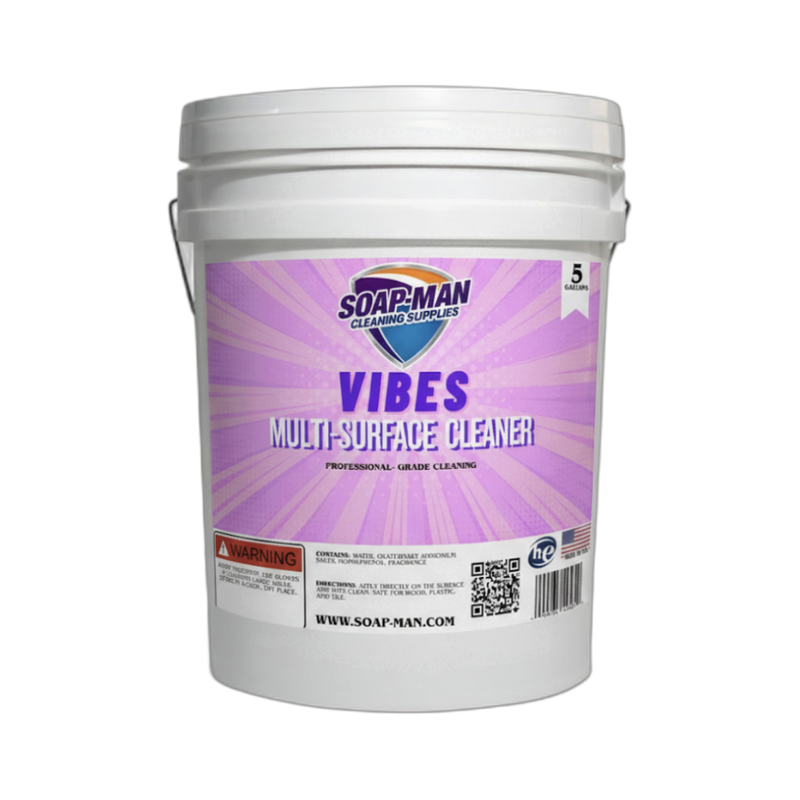
This is the product your team will reach for fifty times a day. Desks, countertops, conference tables, glass doors, fixtures, vinyl chairs, plastic equipment housings — a good multi-surface concentrate handles all of it. The economics here are dramatic. Soap-Man's Vibes Multi-Surface Cleaner dilutes 1:32 to 1:64, meaning a single gallon produces 33 to 65 gallons of working solution. At wholesale pricing, this drops to roughly $0.02 to $0.04 per diluted ounce versus $0.15 to $0.30 per ounce for retail spray bottles. For a 25,000 sqft office, that is the difference between $1,200 a year and $9,000 a year on the same product category.
What to order on day one: 1 case (4 gallons) for facilities under 5,000 sqft, 2 cases for 5,000 to 15,000 sqft, 1 bucket (5 gallons) plus 1 case for anything larger. Stock empty, labeled spray bottles separately.
Category 2 — Heavy-Duty Degreaser (Kitchen, Equipment, Loading Docks)
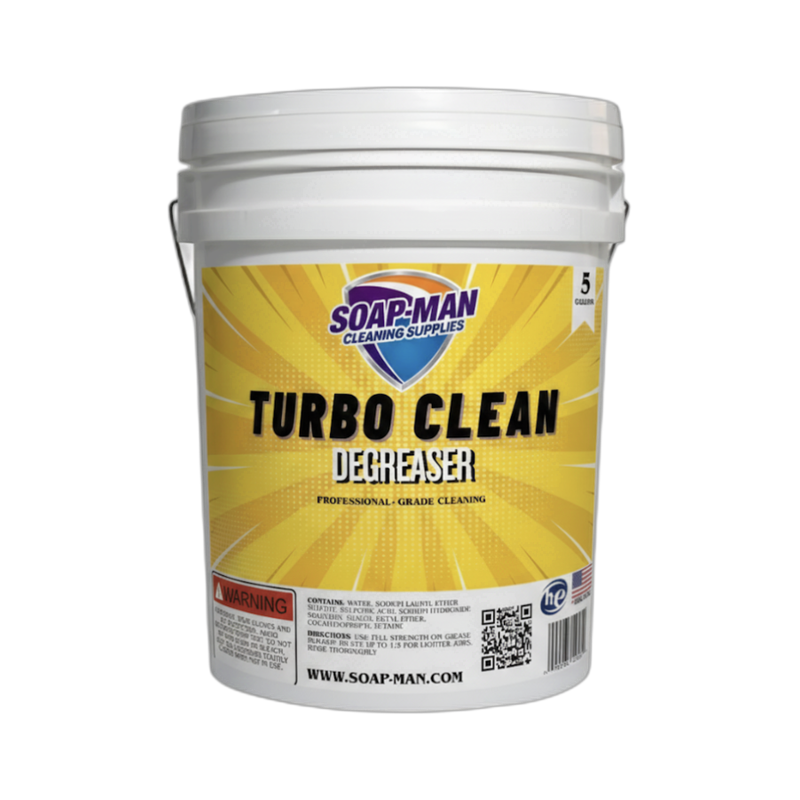
If your facility has a kitchen, a break room, automotive equipment, or a loading dock, you need a high-pH degreaser separate from your daily cleaner. Multi-surface cleaners cannot cut through cooking grease, motor oil, or industrial soil — that is a chemistry limit, not a marketing one. Turbo Clean Degreaser operates at pH 12 to 13, which is what dissolves the long-chain hydrocarbons in cooking grease and petroleum oils.
One operational note that surprises new operators: high-pH degreasers will damage aluminum, raw galvanized steel, and certain anodized finishes if left to dwell. Always rinse aluminum within 5 minutes of degreaser contact, and never use an alkaline degreaser on polished concrete.
What to order on day one: 1 case for offices and retail, 1 to 2 buckets for restaurants, automotive shops, and warehouses.
Category 3 — EPA-Registered Disinfectant (or Bleach)
Disinfectants are the category most new operators get wrong. The labels look similar to all-purpose cleaners, but disinfectants are EPA-registered pesticides regulated under FIFRA. The EPA sets two performance bars: a sanitizer reduces bacteria by 99.9 percent, while a disinfectant kills 99.999 percent of specified pathogens. The label tells you which.
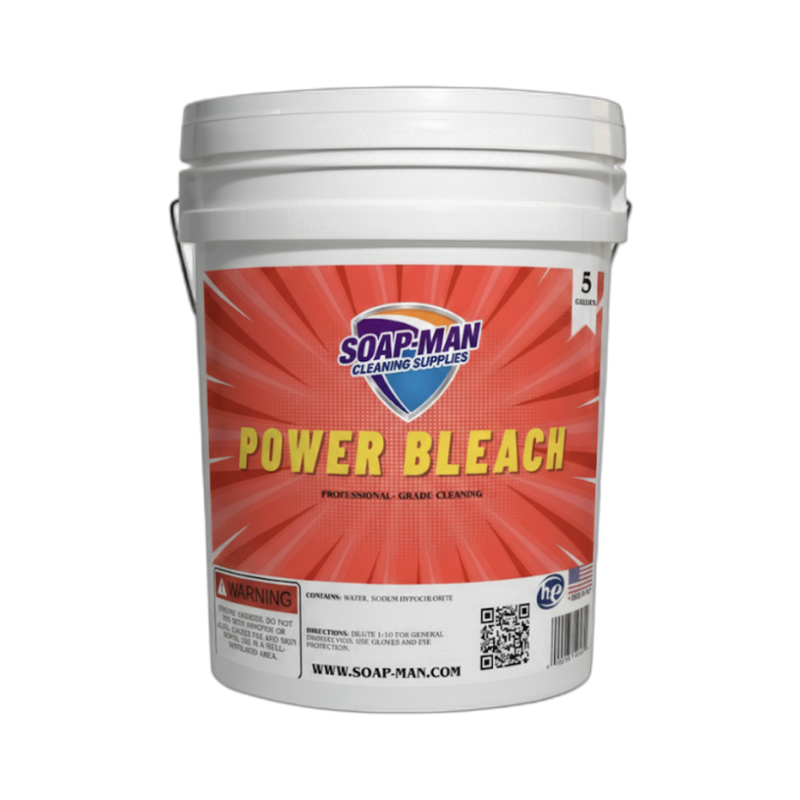
For a general-use facility, Power Bleach at the EPA-recommended dilution (typically 1/3 cup per gallon water for hard non-porous surfaces) hits the disinfectant performance bar for most common pathogens with a 1-minute contact time. Healthcare and childcare facilities may need a quat-based hospital-grade disinfectant with broader-spectrum claims — verify the label against your state requirements.
Critical: never mix bleach with ammonia, vinegar, or other acidic cleaners. The reaction produces chlorine gas. OSHA HazCom requires the SDS for any chemical you use to be on file and accessible to employees.
What to order on day one: 1 case for offices, 1 case to 1 bucket for restaurants and food service, 2 cases minimum for healthcare and childcare facilities.
Category 4 — Glass and Stainless Steel
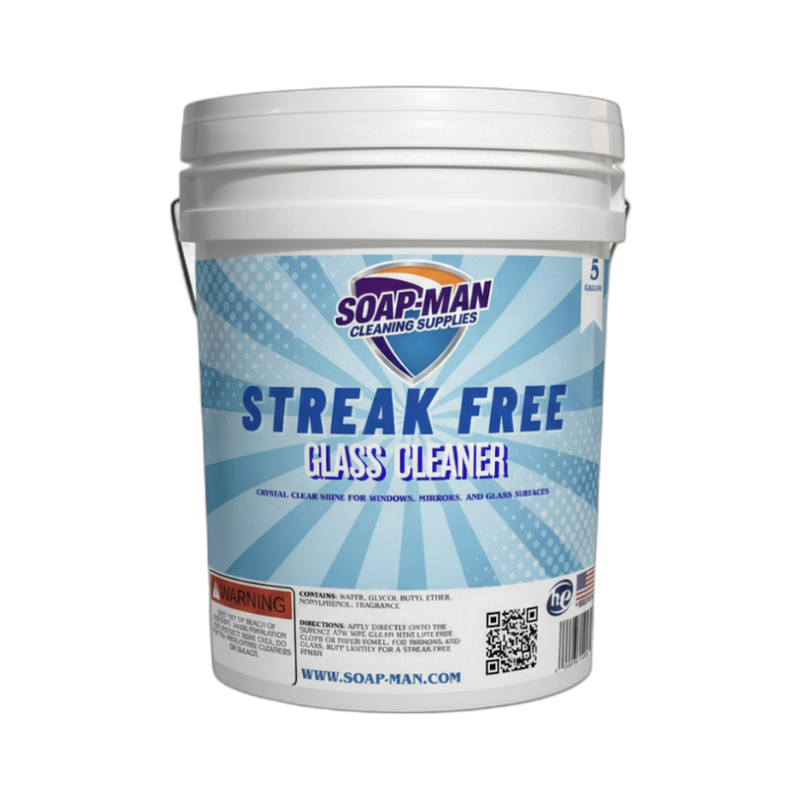
Glass cleaner is technically a luxury — multi-surface cleaner can clean glass. But "can clean" and "leaves no streaks" are different problems. Dedicated glass cleaners use solvents like isopropyl alcohol or proprietary surfactants that flash-evaporate without residue. Streak Free Glass Cleaner is ammonia-free, which matters because ammonia damages tinted glass coatings and anti-reflective films common on modern conference room glass and electronic displays.
What to order on day one: 1 case is plenty for most facilities under 25,000 sqft for the first 6 months.
Category 5 — Floor Care
Floor care chemistry depends on your floor type, which is why you needed to answer that question above. For VCT and ceramic tile, a neutral or mildly alkaline floor cleaner works for daily mopping. For commercial kitchens, the same alkaline degreaser you use on equipment also cleans the floor (use a separate mop and bucket — never cross-contaminate kitchen and front-of-house mops). Pour the chemistry over to your commercial cleaning hub for floor-type-specific protocols.
What to order on day one: Most new businesses can use their multi-surface cleaner or degreaser at higher dilution for floors during month one. Add a dedicated floor finish only if you are running VCT and have a buffer.
Consumables — Paper, Soap, and Trash Liners
Consumables are the highest-volume, most predictable line item in any janitorial program. Order from each of these:
- Hand soap — One pump dispenser per OSHA-required restroom fixture. Plan on roughly 1 oz per 30 hand washes; for a 50-employee office, that works out to roughly 1 gallon every 6 to 8 weeks.
- Toilet paper — Jumbo rolls for commercial dispensers last 3-5x household rolls. Plan 1 roll per 200 to 300 uses.
- Paper towels — Multifold or roll, depending on dispenser. Plan 1 multifold per 1.5 hand washes.
- Trash liners — Sized to your cans (the most common waste in new offices is mismatched bags). Measure can dimensions before ordering.
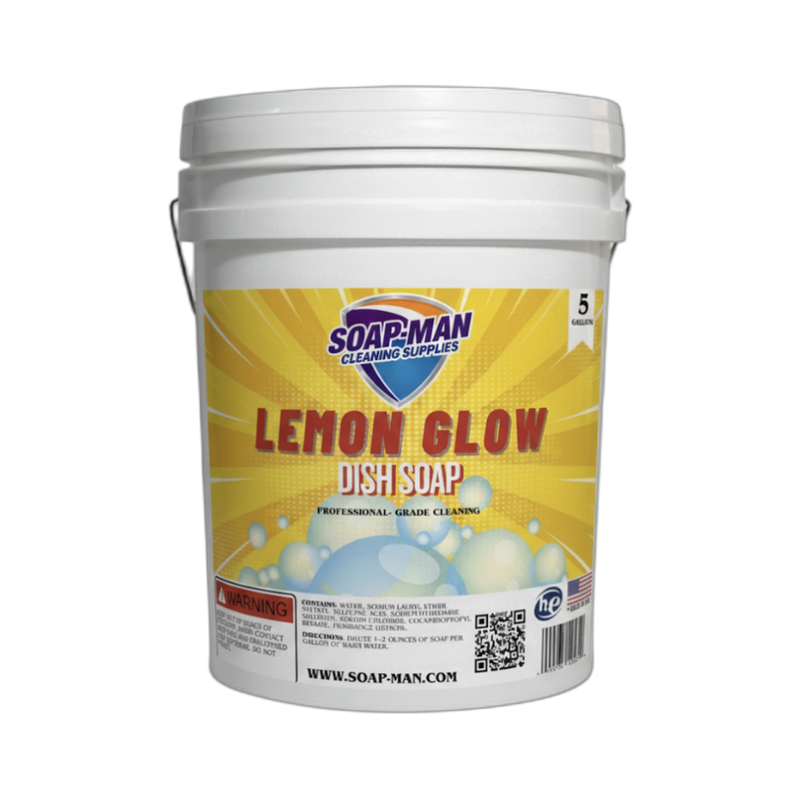
- Dish soap — Even non-restaurants need this for break rooms. Lemon Glow Dish Soap handles a 50-person office break room from a single bucket for roughly a year.
Facility-Type-Specific Additions
Office / Professional Services
Standard 5-category load plus one additional case of glass cleaner if you have a lot of conference room glass. Skip floor stripper and floor finish unless you have VCT.
Restaurant / Food Service
Add: a separate degreaser for back-of-house (you will burn through 1 to 2 buckets per month at moderate volume), commercial dish soap in the case quantity, and an EPA-registered food-contact-surface sanitizer with the label claim for food service. Health code inspections check that you have the right SDS on file (OSHA HazCom 1910.1200).
Retail / Storefront
Add: extra glass cleaner (storefront windows, display cases, refrigerated cases), and a carpet spotter if you have entrance carpeting. A walk-off mat at every entrance reduces interior cleaning labor by 30 to 50 percent over the first quarter, and is one of the cheapest investments you will make.
Medical / Healthcare
Add: a hospital-grade EPA-registered disinfectant with claims against MRSA, C. diff, norovirus, and tuberculosis (verify against your state's healthcare facility requirements). Stock 2x the disinfectant volume of a comparable office because cleaning frequency is roughly double. CDC's Guidelines for Environmental Infection Control in Health-Care Facilities spells out the cleaning cadence — read it before stocking.
Warehouse / Industrial
Add: an industrial-grade alkaline degreaser in 5-gallon buckets (you will use 1 to 3 per month depending on operations), a concrete-safe floor cleaner, and absorbent material (oil-dry or kitty litter) for spills. OSHA 1910.22 requires that aisles be kept clean and dry — slip-and-fall is the second-most-common general industry citation category.
Sample Day-One Order: 25-Employee Office (8,000 sqft)
Here is what a real first order looks like for a typical office, with quantities calibrated to OSHA fixture rules and ISSA production rates.
- 1 case Vibes Multi-Surface Cleaner (4 gallons) — daily cleaning, glass, fixtures
- 1 case Turbo Clean Degreaser (4 gallons) — break room, kitchen, restrooms
- 1 case Power Bleach (4 gallons) — restroom disinfection, food prep
- 1 case Streak Free Glass Cleaner (4 gallons) — conference room glass, mirrors
- 1 case Lemon Glow Dish Soap (4 gallons) — break room dish washing
- 20 cases multifold paper towels
- 10 cases jumbo toilet paper
- 4 cases hand soap (gallon refills)
- 2 cases 33-gallon trash liners, 2 cases 13-gallon trash liners
- 4 microfiber mop heads, 1 mop bucket with wringer, 1 dust mop, 1 broom and dustpan
- 50 microfiber cloths in two colors (color-code by zone — restroom vs. food prep vs. general)
This order runs the typical office for roughly 90 days at moderate use. Beyond month three, monthly reorders shrink to roughly 30 to 50 percent of this initial volume because you are only replacing what you used.
How to Save 30 to 50 Percent on Your Cleaning Supply Budget
The single biggest savings lever is buying concentrate instead of ready-to-use. A retail spray bottle of all-purpose cleaner is 95 percent water by weight. You are paying retail markup, distributor markup, and shipping cost on water you can add at your own facility for free. Concentrates flip the economics: a 1-gallon concentrate at 1:32 dilution produces 33 gallons of working solution, costs roughly $15 wholesale, and replaces $250 of retail-priced spray bottles.
The second lever is volume pricing. Soap-Man's volume pricing kicks in at 6 units, 12 units, and pallet (24 units), with savings up to 40 percent at pallet quantity. Even a 25-employee office hits the 6-unit tier on its first order if it bundles two cases of multi-surface and two cases of paper towels.
The third lever is recurring delivery. Setting up a monthly or quarterly recurring delivery locks in volume pricing automatically and eliminates the emergency-run problem that quietly costs new businesses 10 to 20 percent in retail-store overpaying when they run out mid-week. If you want help sizing a recurring program, the cleaning supply cost calculator models monthly spend by facility type and square footage.
Why Buy from Soap-Man
Soap-Man Cleaning Supplies stocks commercial-grade concentrates only — no retail markups, no diluted formulas dressed up in fancy packaging. We deliver across the East Coast (NJ, NY, PA, MD, DE, CT, VA, MA, RI, DC) with free delivery on orders over $500. New businesses can talk to a real human at (908) 590-8562 for product matching — tell us your facility type, size, and floor types, and we will recommend the exact case counts and dilution ratios. That cuts your day-one order accuracy from "rough guess" to "right the first time."
Ready to place a first order? Request a quote, browse the full product catalog, or contact our team.
Frequently Asked Questions
What's the difference between janitorial supplies and cleaning supplies?
Janitorial supplies is a commercial term covering chemicals, paper products, mops, equipment, and dispensers used in business facilities. Cleaning supplies is the broader retail term that includes both household and commercial products. The functional difference is concentration and packaging: commercial janitorial chemicals are sold as concentrates in 1-gallon and 5-gallon containers and dilute 1:10 to 1:64 with water, while retail cleaning supplies arrive ready-to-use in spray bottles. The per-use cost difference typically runs 5x to 10x in favor of janitorial supplies.
How much should a new business spend on cleaning supplies in the first month?
For a typical office of 5,000 to 15,000 sqft with 25 to 75 employees, expect to spend $400 to $900 on the initial cleaning supply order. Restaurants and food service run roughly 1.5 to 2x that range. Healthcare facilities run roughly 2 to 2.5x. The first order is always larger than steady-state monthly orders because you are stocking from zero. By month four, monthly spend typically settles at 30 to 50 percent of the initial order.
What cleaning supplies are required by OSHA?
OSHA does not mandate specific cleaning products, but several OSHA standards drive cleaning-supply requirements. OSHA 1910.141 mandates accessible toilets and washing facilities (which drives soap, paper towels, and toilet paper consumption). OSHA 1910.1200 (HazCom) requires that you maintain Safety Data Sheets for every chemical product on site and train employees on chemical hazards. OSHA 1910.22 requires that walking surfaces be kept clean and dry to prevent slips, which drives floor cleaner and absorbent stocking. For food service and healthcare, additional state and federal rules layer on top.
Can I use household cleaning products in a commercial facility?
Yes, but it is rarely cost-effective at any scale beyond a small office. Retail products are sold ready-to-use at typically 1 to 5 percent active ingredient concentration; commercial concentrates are sold at 10 to 30 percent active ingredient concentration. For a 5,000 sqft facility, the cost difference between retail and commercial supply is often $400 to $1,000 per month. The performance difference also matters: retail glass cleaners typically cannot match the streak-free finish of a dedicated commercial glass cleaner, and retail disinfectants often lack the EPA-registered label claims that food service and healthcare require.
How long does a 5-gallon bucket of concentrate last?
For a typical 10,000 sqft office at 1:32 dilution, a 5-gallon bucket of multi-surface concentrate produces 165 gallons of working solution and lasts approximately 4 to 6 months at standard daily cleaning frequency. Restaurants burn through degreaser at roughly 4x the office rate. Warehouses with heavy soil load consume degreaser at roughly 6x the office rate. The cleaning supply cost calculator models burn rate by facility type.
Do I need different cleaning supplies for COVID and other respiratory viruses?
Per CDC guidance, regular cleaning with soap and water is sufficient for most respiratory viruses on most surfaces. Disinfection is recommended only when there has been a confirmed case in the space within 24 hours. For confirmed cases, use an EPA List N disinfectant (EPA's list of products effective against SARS-CoV-2 and other emerging viral pathogens) with the contact time on the label. Power Bleach at 1/3 cup per gallon water meets List N criteria for hard non-porous surfaces with a 1-minute contact time.
Should I store cleaning chemicals on site or order as needed?
Store enough on site for 4 to 6 weeks of normal use. Beyond that, you tie up cash in inventory and risk product expiration (most concentrates are stable for 12 to 24 months unopened, but degrade once opened and exposed to air). OSHA 1910.106 governs flammable liquid storage if you stock solvents, and OSHA HazCom requires that all stored chemicals have legible labels and accessible SDS. Recurring delivery programs eliminate the storage-vs-stockout tradeoff by replenishing at a fixed cadence.
What's the cheapest way for a new business to buy cleaning supplies?
Buy commercial concentrates from a wholesale distributor in case or bucket quantities, hit the volume pricing tier (typically 6 units), and set up a recurring delivery to lock in pricing. Avoid retail stores for anything beyond emergency replenishment — markups run 200 to 400 percent. Request a Soap-Man quote for facility-sized pricing, or call (908) 590-8562 to talk through your specific order.