
A commercial floor cleaner is a concentrated cleaning chemical formulated for large-scale floor maintenance in offices, warehouses, restaurants, hospitals, schools, and retail spaces. Unlike household floor cleaners sold at grocery stores, commercial formulas are designed for daily use across thousands of square feet, work with auto-scrubbers and mop systems, and cost 80-90% less per square foot when bought in bulk concentrate.
Choosing the wrong commercial floor cleaner does not just leave floors dirty. It strips finishes, etches surfaces, voids warranties, and creates safety hazards. A single application of an alkaline degreaser on a polished concrete floor can cause a $3 to $8 per square foot restoration bill. That is a $30,000 mistake on a 10,000-square-foot warehouse floor that started with a $12 jug of the wrong product.
This guide covers the five types of commercial floor cleaners, which surfaces each one works on, how to calculate your real cost per square foot, and how to avoid the most expensive mistakes facility managers make. Soap-Man Cleaning Supplies has been providing commercial-grade floor care products to businesses across New Jersey, New York, Pennsylvania, and the entire East Coast with free delivery on orders over $500.
Types of Commercial Floor Cleaners
Every commercial floor cleaner falls into one of five chemical categories based on its pH level and active ingredients. The pH determines what the cleaner can dissolve and which surfaces it is safe to use on. Using the wrong pH on the wrong surface is the single most common cause of commercial floor damage.
Neutral Floor Cleaners (pH 6.5 to 7.5)
Neutral floor cleaners are the workhorses of daily commercial floor maintenance. With a pH close to 7 (the same as pure water), they clean without attacking floor finishes, coatings, or sealers. They lift dirt, dust, and light soil through surfactant action rather than chemical aggression.
Best for: polished concrete, terrazzo, marble, luxury vinyl plank (LVP), luxury vinyl tile (LVT), rubber flooring, sealed hardwood, laminate, and any floor with a protective finish or coating you want to preserve.
Not suited for: heavy grease, oil stains, industrial soils, or floors that need deep stripping. Neutral cleaners maintain clean floors -- they do not rescue neglected ones.
Why pH matters here: polished concrete and terrazzo require a strictly neutral cleaner in the 6.5 to 7.5 range. Even a mildly alkaline cleaner (pH 8 to 9) will etch polished concrete over time, dulling the surface and requiring an expensive diamond regrind at $3 to $8 per square foot. LVP and LVT floors have a thin wear layer that alkaline or acidic chemicals degrade, and once that layer is compromised, the entire floor must be replaced because it cannot be refinished.
Alkaline Floor Cleaners (pH 8 to 12)
Alkaline cleaners use a high pH to break down organic matter: grease, oil, food residue, body oils, and carbon buildup. The higher the pH, the more aggressive the cleaning action. Mildly alkaline cleaners (pH 8 to 10) handle everyday commercial soil. Heavy-duty alkaline degreasers (pH 11 to 13) tackle the toughest industrial grease.
Best for: VCT (vinyl composition tile), ceramic tile, concrete (unsealed), commercial kitchen tile, garage and workshop floors, and warehouse concrete where grease and oil accumulate.
Not suited for: marble, terrazzo, polished concrete, sealed hardwood, LVP, LVT, or rubber flooring. Alkaline chemicals attack calcium-based stone and strip protective coatings.
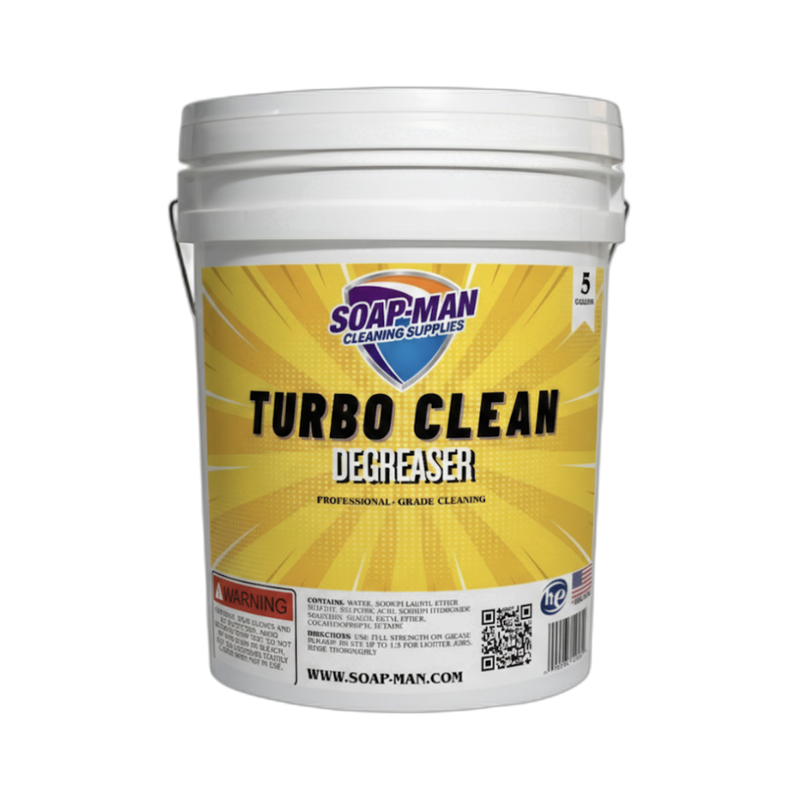
Soap-Man's Turbo Clean Degreaser operates at pH 12 to 13, making it the right choice for commercial kitchen floors, manufacturing facilities, and any surface where petroleum-based oils or cooking grease are the primary soil. At a 1:10 to 1:50 dilution range, a single 5-gallon bucket produces 50 to 250 gallons of working solution.
Acidic Floor Cleaners (pH 1 to 6)
Acidic cleaners dissolve mineral deposits, hard-water scale, rust stains, efflorescence (the white mineral bloom on concrete), and calcium buildup. They work in the opposite direction from alkaline cleaners -- instead of breaking down organic matter, they dissolve inorganic mineral compounds.
Best for: removing hard-water stains from ceramic tile, dissolving efflorescence on concrete, cleaning grout, removing rust stains from industrial floors, and descaling restroom tile.
Not suited for: marble, limestone, terrazzo, travertine (any calcium-based natural stone), polished concrete, or any floor with an acid-sensitive finish. Acids dissolve calcium carbonate, which is the primary component of these materials.
Safety note: acidic floor cleaners require proper PPE including chemical-resistant gloves, splash goggles, and adequate ventilation. Never mix acidic cleaners with bleach -- the reaction produces toxic chlorine gas.
Enzyme-Based Floor Cleaners
Enzyme cleaners use biological catalysts -- proteins that accelerate the breakdown of specific organic compounds. Different enzymes target different soil types: protease breaks down proteins, lipase breaks down fats and oils, amylase breaks down starches, and cellulase breaks down plant-based fibers.
Best for: food processing facilities, healthcare environments with biological stains, commercial kitchens with protein and fat buildup, pet care facilities, and any space with persistent organic odors. Enzymes continue working after application, digesting organic matter embedded in grout lines and textured surfaces that chemical cleaners only reach on the surface.
Not suited for: inorganic soils (mineral deposits, rust, scale), heavy petroleum-based grease, or situations requiring rapid disinfection. Enzymes work slowly compared to chemical cleaners -- they need 10 to 30 minutes of dwell time versus 30 to 60 seconds for alkaline degreasers.
Disinfectant Floor Cleaners
Disinfectant floor cleaners combine cleaning surfactants with EPA-registered antimicrobial agents that kill bacteria, viruses, and fungi on floor surfaces. These are not general cleaners with a vague "kills germs" claim -- they are EPA-registered products with specific organism kill lists on their labels.
Best for: healthcare facilities, schools, daycare centers, food prep areas, restrooms, and any space where infection control is required by regulation or best practice.
Not suited for: general daily floor cleaning where disinfection is unnecessary. Overusing disinfectants wastes money, contributes to antimicrobial resistance, and can leave residue that dulls floor finishes.
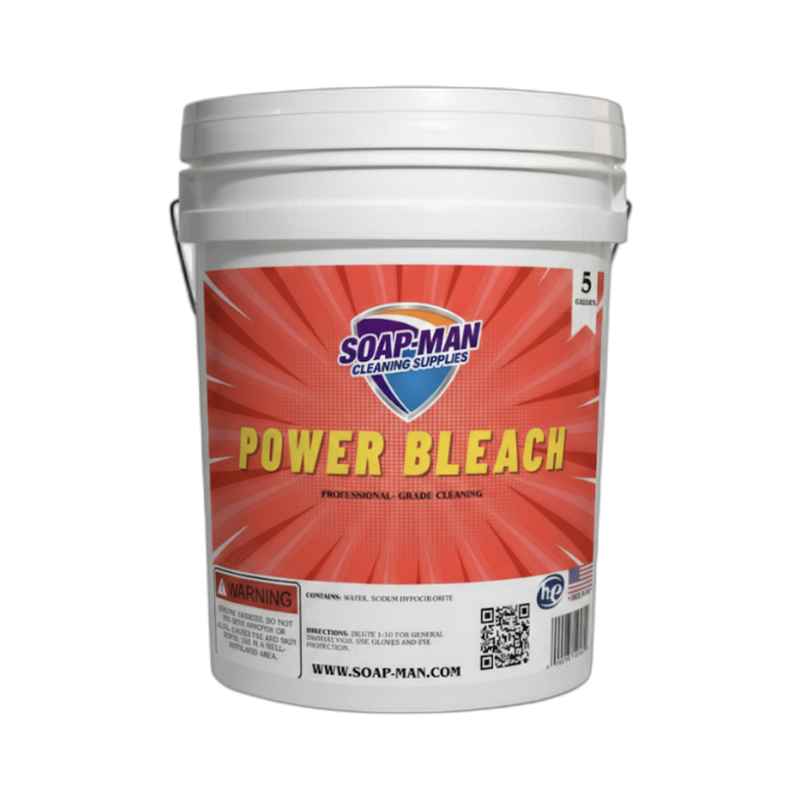
Soap-Man's Power Bleach provides EPA-registered broad-spectrum disinfection at commercial concentrations for floors that require true pathogen elimination.
Commercial Floor Cleaner by Surface Type
The most expensive mistake in commercial floor care is choosing a cleaner based on what you want to remove rather than what the floor is made of. The floor material dictates the chemistry. Here is the definitive matching guide.
| Floor Type | Required pH Range | Cleaner Type | Daily Method | Avoid |
|---|---|---|---|---|
| VCT (Vinyl Composition Tile) | 8.0 - 10.0 | Mildly alkaline | Dust mop + damp mop or auto-scrub | Acidic cleaners, abrasive pads |
| Polished Concrete | 6.5 - 7.5 (strict) | Neutral only | Dust mop + damp mop | ANY alkaline or acidic product |
| Ceramic Tile | 7.0 - 10.0 | Neutral to mildly alkaline | Auto-scrub or mop | Acidic cleaners on grout (long term) |
| Terrazzo | 6.5 - 7.5 (strict) | Neutral only | Dust mop + damp mop | ANY alkaline or acidic product |
| Epoxy-Coated Concrete | 7.0 - 12.0 | Neutral to alkaline degreaser | Auto-scrub with degreaser | Acidic cleaners, floor strippers |
| LVP / LVT (Luxury Vinyl) | 6.5 - 7.5 (strict) | Neutral, no-rinse | Dust mop + damp mop | Wax, finish, alkaline strippers |
| Rubber Flooring | 6.5 - 7.5 | Neutral, low moisture | Damp mop only | Solvents, petroleum-based cleaners |
| Sealed Hardwood | 6.5 - 7.5 | Neutral, minimal water | Spray mop with microfiber | Excess water, alkaline cleaners, vinegar |
| Unsealed Concrete | 8.0 - 13.0 | Alkaline degreaser | Auto-scrub or pressure wash | Neutral cleaners (insufficient for industrial soil) |
| Commercial Kitchen Tile | 10.0 - 13.0 | Heavy-duty alkaline degreaser | Auto-scrub, daily degrease | Neutral cleaners (won't cut grease) |
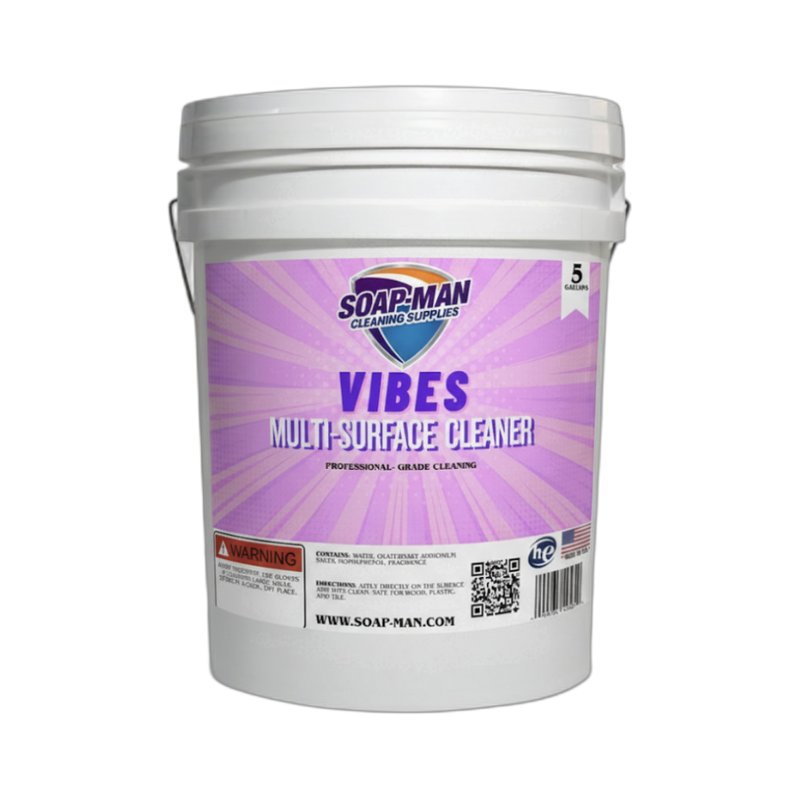
Soap-Man's Vibes Multi-Surface Cleaner at pH 9 to 10 covers the mildly alkaline range for VCT, ceramic tile, and general daily cleaning across most commercial surfaces. For heavy grease on kitchen and warehouse floors, step up to Turbo Clean Degreaser at pH 12 to 13.
How to Calculate Your Real Cost Per Square Foot
Most facility managers compare floor cleaners by the price on the label. That is like comparing cars by sticker price without looking at fuel economy. The real metric is cost per square foot of floor cleaned, and concentrates crush ready-to-use products on this metric every single time.
| Product Format | Purchase Price | Dilution Ratio | Working Solution | Coverage (at 1 gal/1,000 sq ft) | Cost Per Sq Ft |
|---|---|---|---|---|---|
| RTU spray mop refill (32 oz) | $5.99 | None (ready to use) | 0.25 gallons | 250 sq ft | $0.024 |
| 1-gallon concentrate (1:32) | $16.75 | 1:32 | 33 gallons | 33,000 sq ft | $0.0005 |
| 5-gallon bucket concentrate (1:32) | $58.00 | 1:32 | 165 gallons | 165,000 sq ft | $0.0004 |
| Pallet (24x 5-gallon buckets) | $35.00/bucket | 1:32 | 3,960 gallons | 3,960,000 sq ft | $0.0002 |
A facility with 20,000 square feet of floor mopped daily would use roughly 20 gallons of working solution per day, or about 5,200 gallons per year. At RTU pricing, that costs $124,800 annually. At 5-gallon concentrate pricing, that same coverage costs $1,827. The annual savings is over $120,000 -- on floor cleaner alone.
Even at modest scale, the math is overwhelming. A 5,000-square-foot office mopped three times per week uses about 780 gallons of working solution annually. RTU cost: $18,720. Concentrate cost: $274. That is the difference between buying concentrate from Soap-Man and buying spray bottles from a retail store.
Choosing a Commercial Floor Cleaner: Decision Framework
Follow these four steps in order. Do not skip to step four (price) without completing steps one through three first -- that is how floors get damaged.
Step 1: Identify Every Floor Surface in Your Facility
Walk your facility and document every floor type. Most commercial buildings have multiple floor types: VCT in hallways, ceramic tile in restrooms, concrete in loading docks, carpet in offices, and possibly terrazzo or LVP in lobbies. Each surface needs its own cleaner or at minimum a cleaner compatible with all of them.
Step 2: Match Chemistry to Surface
Use the surface compatibility table above to determine the required pH range for each floor type. If you have a mix of VCT (pH 8-10) and polished concrete (pH 6.5-7.5) in the same building, you need two different cleaners -- not one "all-purpose" product at a compromise pH that slowly damages both surfaces.
Step 3: Match Chemistry to Soil Type
Identify what you are cleaning off the floor:
- General dust and foot traffic soil -- neutral or mildly alkaline cleaner
- Cooking grease and food oils -- alkaline degreaser (pH 10+)
- Petroleum-based oils and industrial grease -- heavy-duty alkaline degreaser (pH 12+)
- Hard-water scale, mineral deposits, rust -- acidic cleaner
- Biological matter, protein, persistent odor -- enzyme-based cleaner
- Pathogens requiring disinfection -- EPA-registered disinfectant floor cleaner
Step 4: Evaluate Cost, Format, and Supplier
Only after confirming chemical compatibility should you compare pricing. Key considerations:
- Concentrate vs. RTU -- always choose concentrate for facilities over 1,000 square feet. The cost savings are 90% or more.
- Dilution range -- a wider dilution range (like 1:10 to 1:50 on Turbo Clean Degreaser) gives you flexibility to mix stronger for heavy soil and weaker for light maintenance without buying a second product.
- Auto-scrubber compatibility -- if you use a floor machine, confirm the cleaner is low-foaming. High-foam cleaners clog auto-scrubber vacuum systems and leave residue.
- Volume pricing -- Soap-Man offers volume discounts starting at 6 units, with savings up to 40% at pallet quantities of 24 buckets.
Commercial Floor Cleaner Application Methods
The best commercial floor cleaner delivers poor results when applied incorrectly. Method matters as much as chemistry.
Mop and Bucket
Traditional mopping works for spaces under 5,000 square feet and daily light maintenance. Use the two-bucket method: one bucket with cleaning solution, one with clean rinse water. A single-bucket method just spreads dirty water around. Wring the mop to damp, not dripping -- excess water damages wood, LVP, and can cause slip hazards. Microfiber flat mops clean 20% more effectively than cotton string mops and hold less water, reducing dry time and slip risk.
Auto-Scrubber
For facilities over 5,000 square feet, an auto-scrubber reduces labor by 60-80% compared to manual mopping. The machine dispenses solution, scrubs with rotating brushes or pads, and vacuums up dirty water in a single pass. Key requirement: use low-foam floor cleaners only. Standard cleaners generate foam that fills the recovery tank and starves the vacuum motor. Most commercial concentrates are formulated for auto-scrubber use -- check the label for "low-foam" or "machine compatible."
Spray and Buff / Burnish
For VCT floors with a wax finish, spray buffing maintains gloss between full strip-and-recoat cycles. Apply a light mist of neutral cleaner or spray buff solution, then burnish at 1,500+ RPM with a white polishing pad. This removes scuff marks and restores shine without stripping the finish layer. Frequency: weekly in high-traffic areas, monthly in low-traffic zones.
Pressure Washing
For outdoor concrete, loading docks, and drive-through lanes, pressure washing at 2,000 to 3,000 PSI removes embedded oil and years of grime that mopping cannot touch. Pre-treat with alkaline degreaser (let it dwell 10 to 15 minutes), then pressure wash. Soap-Man's Turbo Clean Degreaser is compatible with pressure washing systems.
Common Commercial Floor Cleaner Mistakes
These mistakes cost businesses thousands of dollars in floor damage, premature replacement, and voided warranties every year. Every one of them is preventable.
Mistake 1: Using One Cleaner on Every Floor
The "universal cleaner" does not exist in commercial floor care. A multi-surface cleaner like Vibes Multi-Surface Cleaner handles countertops, desks, glass, and many hard floors -- but it is not safe for every floor surface at every dilution. Polished concrete and terrazzo require a strictly neutral product. Kitchen floors require a degreaser. A single all-purpose cleaner at pH 9 will slowly damage polished concrete while being too weak for kitchen grease.
Mistake 2: Applying Floor Finish to LVP or LVT
LVP and LVT have a factory-applied wear layer that is the floor's protective surface. Applying wax, finish, or any floor coating on top of that factory layer causes yellowing, peeling, and an ugly buildup that is extremely difficult to remove. LVP and LVT need only a neutral no-rinse cleaner and a damp mop. Never strip, never wax, never seal. Doing so voids the manufacturer warranty and creates a floor that looks worse than it did before treatment.
Mistake 3: Overusing Disinfectant on General Floors
Disinfectant floor cleaners leave a residue that builds up over time, dulling floor finishes and creating a sticky film that attracts more dirt. Unless the floor requires disinfection for regulatory or health reasons (restrooms, healthcare patient areas, food prep zones), use a standard neutral or mildly alkaline cleaner for daily maintenance. Reserve disinfectant cleaning for the surfaces and situations that genuinely require it.
Mistake 4: Ignoring Dilution Ratios
More concentrate does not mean more clean. Over-concentrating floor cleaner wastes product, leaves residue, creates slip hazards, and can damage floor surfaces. Under-concentrating wastes labor because the cleaner does not work effectively and you end up making extra passes. Follow the manufacturer's dilution ratio exactly. A proportioning dispenser or dilution control system costs $30 to $100 and pays for itself within a month by preventing both waste and damage.
Mistake 5: Skipping Dust Mopping Before Wet Cleaning
Wet-mopping or auto-scrubbing a floor covered in loose dust, sand, and grit turns those particles into abrasive slurry that scratches floor finishes with every pass. Always dust mop or sweep first to remove loose particulate, then wet clean. This simple step extends floor finish life by 30-50% and reduces stripping frequency from twice a year to once a year on VCT floors.
Commercial Floor Cleaner Maintenance Schedules by Facility
How often you clean -- and how aggressively -- depends on your facility type and traffic volume. Here are professional maintenance schedules that balance floor appearance, longevity, and labor costs.
| Facility Type | Daily | Weekly | Monthly | Annually |
|---|---|---|---|---|
| Office (5,000-20,000 sq ft) | Dust mop + spot clean | Full damp mop or auto-scrub | Burnish high-traffic areas | Strip and recoat (VCT only) |
| Restaurant / Food Service | Full degrease mop or auto-scrub | Deep scrub grout lines | Machine scrub entire floor | Grout restoration + reseal |
| Healthcare Facility | Disinfectant mop all patient areas | Auto-scrub corridors | Burnish or refinish high-traffic zones | Full strip and recoat |
| Warehouse / Manufacturing | Dust mop or ride-on sweeper | Auto-scrub with degreaser | Pressure wash loading docks | Deep degrease + reseal (if coated) |
| Retail Store | Dust mop + spot clean | Auto-scrub or full mop | Burnish entrance and checkout areas | Strip and recoat (VCT) or deep clean |
| School / University | Dust mop + spot clean high-traffic | Full mop or auto-scrub | Burnish corridors and cafeteria | Summer strip and recoat (VCT) |
Why Businesses Choose Soap-Man for Commercial Floor Cleaners
Soap-Man Cleaning Supplies provides commercial-grade floor care products to businesses across the East Coast from New Jersey to Virginia. Here is why facilities choose us over big-box stores, Amazon, and national distributors:
- Commercial-grade concentrates only. Every product in our catalog is formulated for professional use. Our Vibes Multi-Surface Cleaner dilutes 1:32 to 1:64, producing 33 to 65 gallons of working solution from a single gallon of concentrate. Our Turbo Clean Degreaser tackles the industrial grease that general cleaners cannot touch.
- Volume discounts starting at 6 units. No minimum order on most products, but pricing drops at 6, 12, and pallet quantities of 24 units. Save up to 40% at pallet volume.
- Free delivery on orders over $500. We deliver directly to your facility across NJ, NY, PA, MD, CT, DE, VA, MA, RI, and Washington DC. Same-day delivery available for orders placed before 12 PM.
- Expert product matching. Call (908) 590-8562 and tell us your floor types, soil types, and facility size. We will recommend the exact products and dilution ratios for your operation -- no guesswork, no expensive trial-and-error, no damaged floors.
- Recurring delivery programs. Set your schedule -- weekly, bi-weekly, or monthly -- and never run out of floor cleaner mid-shift. Recurring orders also lock in volume pricing automatically.
Ready to switch to commercial-grade floor cleaners? Request a free quote or contact our team to discuss your facility's floor care needs.
Frequently Asked Questions About Commercial Floor Cleaners
What is a commercial floor cleaner?
A commercial floor cleaner is a concentrated cleaning chemical designed for maintaining floors in businesses, facilities, and institutions. Unlike household products sold ready-to-use in spray bottles, commercial floor cleaners are concentrated formulas that dilute with water at ratios from 1:10 to 1:64, producing 10 to 65 gallons of working solution from a single gallon of concentrate. They are engineered for daily use across large areas and work with professional equipment like auto-scrubbers, mop systems, and pressure washers.
What is the best commercial floor cleaner for all surfaces?
No single floor cleaner is safe for every surface. Polished concrete, terrazzo, and luxury vinyl require a strictly neutral cleaner (pH 6.5-7.5). VCT and ceramic tile tolerate mildly alkaline cleaners (pH 8-10). Commercial kitchen floors and warehouses need heavy-duty alkaline degreasers (pH 10-13). The safest approach is to stock a neutral daily cleaner for sensitive surfaces and an alkaline degreaser for grease-prone areas. Soap-Man's Vibes Multi-Surface Cleaner (pH 9-10) handles most general commercial surfaces, while Turbo Clean Degreaser (pH 12-13) handles heavy industrial soil.
How much does commercial floor cleaner cost?
Commercial floor cleaner concentrate costs $12 to $25 per gallon at retail, or $5 to $18 per gallon at wholesale. However, the meaningful metric is cost per square foot cleaned. A 5-gallon bucket of concentrate at 1:32 dilution covers approximately 165,000 square feet at a cost of $0.0004 per square foot. Ready-to-use retail products cost roughly $0.024 per square foot -- 60 times more expensive per area cleaned.
What pH floor cleaner should I use on polished concrete?
Polished concrete requires a strictly neutral floor cleaner with a pH between 6.5 and 7.5. Using a cleaner outside this range -- even a mildly alkaline all-purpose cleaner at pH 9 -- will etch the polished surface over time, causing a dull haze that requires professional diamond regrinding at $3 to $8 per square foot to restore. Always verify the pH on the product label or safety data sheet before using any cleaner on polished concrete.
Can I use the same floor cleaner in a mop bucket and auto-scrubber?
Yes, as long as the cleaner is a low-foam formula. High-foam cleaners generate excessive suds inside auto-scrubber recovery tanks, which fills the tank with foam instead of dirty water, starves the vacuum motor, and can damage the machine. Most commercial concentrates are formulated as low-foam products specifically because they are designed for machine use. Check the label for "low-foam," "machine compatible," or "auto-scrubber safe" before adding any cleaner to your machine's solution tank.
How often should commercial floors be cleaned?
Frequency depends on facility type and foot traffic. Offices typically need daily dust mopping with weekly wet cleaning. Restaurants need daily degreasing. Healthcare facilities require daily disinfectant mopping in patient areas. Warehouses need daily sweeping with weekly auto-scrubbing. High-traffic areas like entrances, corridors, and checkout zones may need twice-daily attention regardless of facility type.
What is the difference between a floor cleaner and a floor stripper?
A floor cleaner removes soil, dirt, and light stains from the floor surface without affecting the floor's finish or coating. A floor stripper is a highly alkaline chemical (pH 12-14) designed to dissolve and remove floor finish, wax, and sealers entirely -- stripping the floor back to its base material for a fresh finish application. Strippers are used once or twice a year on VCT floors as part of a strip-and-recoat cycle. Using a stripper when you need a cleaner will destroy your floor finish unnecessarily.
Where can I buy commercial floor cleaner in bulk?
Commercial cleaning supply distributors like Soap-Man offer bulk floor cleaner at wholesale pricing that saves 30-50% over retail stores. Soap-Man delivers commercial floor cleaners in 1-gallon cases and 5-gallon buckets across the East Coast with free delivery on orders over $500. Volume discounts start at just 6 units. Request a custom quote or call (908) 590-8562 for facility-specific pricing and product recommendations.