
If you have ever stood in front of a janitorial catalog wondering why one product is labeled "sanitizer" and the next one is labeled "disinfectant" — and whether it actually matters which one you stock — the answer is yes, it matters, and the difference is enforced by federal law. The EPA classifies antimicrobial products under the Federal Insecticide, Fungicide, and Rodenticide Act (FIFRA), and the classifications are not marketing — they are legal performance categories with distinct testing requirements. This is the guide most facility managers wish someone had handed them on day one.
The Three Legal Categories
Under FIFRA, antimicrobial products that make pathogen-kill claims are regulated as pesticides — the EPA literally classifies them in the same registration system as agricultural pesticides. Three performance categories exist, in increasing order of strength:
1. Cleaner
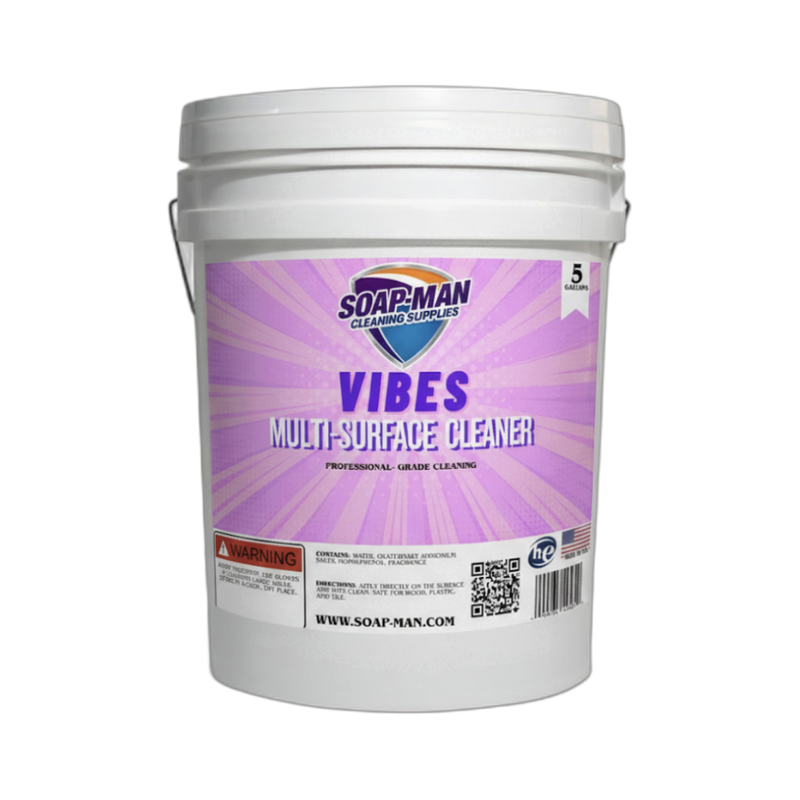
A cleaner removes soil, dust, and visible contaminants from a surface. Cleaners are not pesticides. They make no pathogen-kill claims and are not regulated by EPA under FIFRA. Multi-surface cleaners, glass cleaners, degreasers, and dish soaps fall into this category. Cleaning physically removes pathogens along with soil, but the manufacturer cannot claim a specific log-reduction or kill rate without registering as a pesticide. Vibes Multi-Surface Cleaner is a cleaner — it is excellent at removing soil and pathogens by physical action, but does not carry a disinfectant or sanitizer label.
2. Sanitizer
A sanitizer reduces bacteria on a surface by 99.9 percent (a 3-log reduction) within 30 seconds to 5 minutes of contact. Sanitizers must be EPA-registered as antimicrobial pesticides, but the testing bar is lower than for disinfectants. Two sub-categories exist: food-contact sanitizers (used on dishes, food prep surfaces, utensils) and non-food-contact sanitizers (used on toilets, floors, walls). Food-contact sanitizers must additionally be FDA-cleared for direct food-surface contact. Quaternary ammonium ("quat") and chlorine-based products are common sanitizer chemistries.
3. Disinfectant
A disinfectant kills 99.999 percent (a 5-log reduction) of specified pathogens within the contact time on the label. Disinfectants must be EPA-registered with specific organism claims — the label lists exactly which pathogens it kills (Staphylococcus aureus, MRSA, Salmonella, Norovirus, Hepatitis A, etc.). Disinfectants are tested against each specific organism the manufacturer wants to claim, and the EPA verifies the testing before approving the registration. Hospital-grade disinfectants are a sub-category that must additionally kill Pseudomonas aeruginosa, Staphylococcus aureus, and Salmonella enterica — the EPA's three baseline pathogens for hospital settings.
The functional rule: a disinfectant always also satisfies the sanitizer threshold. A sanitizer does not necessarily satisfy the disinfectant threshold. A cleaner does neither, even if the chemistry happens to remove pathogens by physical action.
How to Read an EPA Label
Every EPA-registered antimicrobial product has a label that contains the same set of legally required information. Knowing what to look for takes 30 seconds and prevents 90 percent of selection mistakes.
- EPA Registration Number — A two- or three-part number (e.g., 6836-78). This is the unique identifier in EPA's pesticide product database. You can look up any registration number at EPA's PPLS to verify the product is still registered.
- Active Ingredient — The chemical that does the antimicrobial work, typically listed as a percentage. Common active ingredients: sodium hypochlorite (chlorine bleach), quaternary ammonium ("quat"), hydrogen peroxide, accelerated hydrogen peroxide, peroxyacetic acid, isopropyl alcohol.
- Use Sites — Where the product is approved for use (hospitals, food service, daycare, animal facilities, etc.). Using a product outside its approved use sites is technically a FIFRA violation.
- Pathogen Claims — The specific organisms the product is registered to kill, listed by genus and species (Staphylococcus aureus, Norovirus, etc.). If a pathogen is not on the label, the product is not registered to kill it.
- Contact Time (Dwell Time) — The number of minutes the product must remain wet on the surface to achieve the claimed kill. Contact time varies by pathogen — a single product might kill Staph in 1 minute but require 10 minutes for Norovirus.
- Dilution Instructions — For concentrate products, the exact dilution ratio (e.g., 1/3 cup per gallon water). Using a different dilution voids the EPA registration claims.
- Signal Word — Caution, Warning, or Danger, indicating toxicity. Most consumer-facing disinfectants are Caution or Warning.
The Contact Time Trap
This is the rule operators most commonly violate, and it is the rule that determines whether disinfection actually worked. EPA contact times are measured under controlled lab conditions: the product is applied to a hard non-porous surface, kept wet for the specified time, and the surface is then tested for pathogen reduction.
In real-world use, the surface usually dries before the contact time expires. A common scenario: an operator sprays disinfectant on a restroom counter, immediately wipes it dry. The contact time was maybe 15 seconds. The product is registered for a 1-minute, 5-minute, or 10-minute contact time depending on pathogen. The registered kill claim does not apply at 15 seconds. The surface is "cleaner" but not "disinfected" in any legally meaningful sense.
The fix is straightforward but operationally unfamiliar to most teams: spray the surface, let it dwell, and only then wipe (or let air-dry per the label). For surfaces that dry quickly (porous, hot, ventilated), re-apply during the contact time to keep the surface wet. Some products are formulated as "ready-to-use" with humectants that extend wet time — check the label.
EPA List N: The COVID-19 Reference List
During the COVID-19 pandemic, the EPA created List N: a list of EPA-registered disinfectants expected to be effective against SARS-CoV-2. List N became the canonical reference for "is this product effective against COVID-19?" — and it is still maintained.
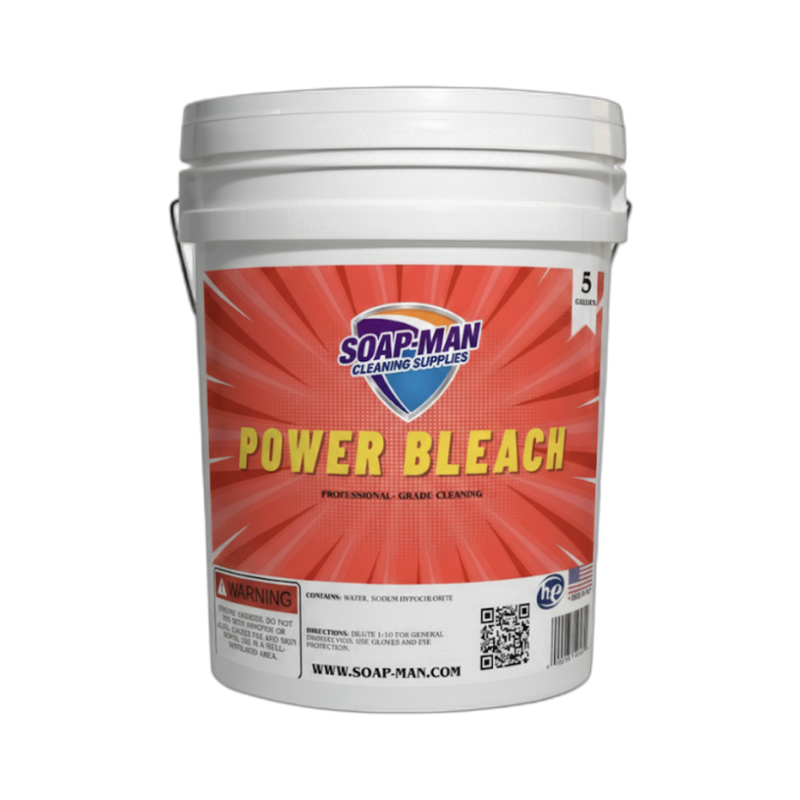
List N is still relevant because it functions as a clear, accessible registry of disinfectant products that meet EPA's "emerging viral pathogen" guidance — the framework the EPA uses to authorize disinfectant claims for novel viruses without requiring decades of new testing. List N includes the registration number, active ingredient, contact time, and approved use sites for each listed product. For facilities choosing a disinfectant for general respiratory virus protection, List N is a reasonable starting point. Power Bleach at the appropriate dilution meets List N criteria for hard non-porous surfaces with a 1-minute contact time.
Practical Selection Guide by Facility Type
Office and Professional Services
A general-purpose EPA-registered disinfectant for restrooms and high-touch surfaces. Pathogen claims should include common cold and flu viruses, Staph, Salmonella, and List N. Quat-based products are common and operator-friendly. Bleach-based products are cheaper and broader-spectrum but more aggressive on materials.
Restaurant and Food Service
Two products: an EPA-registered food-contact sanitizer for dishes, prep surfaces, and utensils (must be FDA-cleared for food contact), and a separate disinfectant for restrooms and back-of-house. Food-contact sanitizers must be used at the precise dilution on the label — over-concentration leaves chemical residue on food contact surfaces; under-concentration fails to sanitize. Many health codes require chlorine test strips or quat test strips on site to verify sanitizer dilution at point of use.
Medical and Healthcare
Hospital-grade EPA-registered disinfectant with claims against MRSA, C. difficile (note: most regular disinfectants do not kill C. diff — bleach or accelerated hydrogen peroxide is typically required), Norovirus, Tuberculosis, and Hepatitis A and B. CDC's Guidelines for Environmental Infection Control spell out cleaning cadence by area type. Many states layer additional disinfection requirements on top of EPA registration.
Childcare and Schools
EPA-registered sanitizer for diaper changing tables, toys, and food-prep surfaces (food-contact sanitizer for any surface that contacts food); disinfectant for restrooms. Many childcare regulations specify approved active ingredients (often EPA Safer Choice products are preferred for child-occupied spaces). State licensing typically lists approved products or active ingredients.
Warehouse and Industrial
Restrooms and break rooms need EPA-registered disinfectant. Production floors typically only need cleaning (no specific pathogen-kill requirement) unless the facility handles food or pharmaceuticals.
Common Mistakes
- Using a sanitizer where a disinfectant is required. Sanitizers reduce bacteria but are not registered to kill viruses. For respiratory virus or norovirus protection, you need a disinfectant.
- Wiping before contact time elapses. The single most common operator mistake. Spray, dwell, then wipe — not spray-and-wipe in one motion.
- Mixing disinfectants and cleaners. Many disinfectants are inactivated by heavy soil. The proper sequence is clean first (remove soil), then disinfect (apply EPA-registered product). Combining steps with a "one-step" product is allowed only when the product is specifically registered as a one-step cleaner-disinfectant.
- Cross-mixing chemistries. Bleach + ammonia = chlorine gas. Bleach + acid (vinegar, toilet bowl cleaners) = also chlorine gas. Quat + bleach = inactivation. OSHA HazCom 1910.1200 requires SDS access; check incompatibility before storage decisions.
- Using an expired product. EPA-registered antimicrobials have expiration dates. Beyond the date, the active ingredient concentration drops and the registered kill claims no longer apply.
- Buying without checking the EPA registration number. Counterfeit or mislabeled products spike during health emergencies. Look up the EPA reg number in PPLS — if it does not match, the product is not legally an antimicrobial.
What Soap-Man Stocks
Soap-Man's antimicrobial product is Power Bleach, a sodium hypochlorite product that meets EPA disinfectant criteria for hard non-porous surfaces at the proper dilution. Sodium hypochlorite is one of the broadest-spectrum disinfectant active ingredients available — effective against bacteria, viruses (including List N for emerging viral pathogens), and bacterial spores at higher concentrations. The trade-offs are operator-known: aggressive on metals if not rinsed, must not be mixed with acidic cleaners, and degrades faster than quat-based products in storage.
For multi-surface cleaning (Category 1), Soap-Man stocks Vibes Multi-Surface Cleaner (excellent for soil removal — not a sanitizer or disinfectant). For heavy degreasing, Turbo Clean Degreaser at pH 12-13 (also not a registered disinfectant). The proper protocol for restrooms and high-touch surfaces: clean first with multi-surface or degreaser, then apply Power Bleach at proper dilution and dwell for the contact time.
If you need a quat-based sanitizer or a hospital-grade specialty disinfectant for healthcare or food service compliance, talk to our team at (908) 590-8562. We can source the right EPA registration for your specific use case. For general facility planning, the bathroom and restroom cleaning hub walks through restroom disinfection protocols, and the commercial cleaning hub covers full-facility programs.
Frequently Asked Questions
Is hand sanitizer a sanitizer?
Legally, no — hand sanitizers are regulated by the FDA as over-the-counter drugs (under the topical antiseptic monograph), not by EPA as antimicrobial pesticides. The word "sanitizer" in the FDA hand-sanitizer context is unrelated to the EPA's surface-sanitizer category. FDA-regulated hand sanitizers must contain at least 60% alcohol (or be benzalkonium chloride based) to claim antimicrobial efficacy on skin. EPA-regulated surface sanitizers are an entirely different product class with different testing.
Can I use the same product as a cleaner and a disinfectant?
Yes, if the product is specifically labeled as a "one-step cleaner-disinfectant" with EPA registration covering both functions. These products are formulated to clean (remove soil) and disinfect (kill pathogens) in a single application. Most products are not one-step — you must clean first to remove soil, then apply the disinfectant for the registered contact time. The label tells you which.
What does "5-log reduction" mean?
A 5-log reduction is a 99.999% reduction in pathogen count — equivalently, the surviving organisms are reduced to 1/100,000 of the starting count. Disinfectants must achieve this against tested pathogens. Sanitizers must achieve a 3-log reduction (99.9%) — surviving organisms reduced to 1/1,000 of starting count. The two-log gap matters: sanitizing reduces bacteria but is insufficient for hospital, food-contact-after-handling-raw-meat, or norovirus exposure scenarios.
Does the EPA test every product registered as a disinfectant?
The EPA reviews testing data submitted by the manufacturer; it does not run its own tests in most cases. The manufacturer must conduct EPA-protocol-compliant efficacy testing for each pathogen claim and submit the data with the registration application. EPA reviews the data, may request additional testing, and audits a portion of registered products through its Stewardship and Compliance program. Counterfeit or unregistered antimicrobial products do appear in the market, especially during health emergencies — verify EPA reg numbers in PPLS before stocking unfamiliar brands.
What's the difference between Safer Choice and EPA-registered disinfectant?
EPA Safer Choice is a separate EPA program that certifies cleaning products (mostly cleaners, some sanitizers) for human and environmental safety. Safer Choice products meet a chemical-ingredient screening standard for low-toxicity ingredients. Safer Choice is not a disinfectant standard — most Safer Choice certified products are cleaners, not antimicrobials. A product can be EPA Safer Choice certified and not registered as a disinfectant; another product can be a registered disinfectant and not Safer Choice certified.
How long should I dwell a disinfectant?
Whatever the label says for the specific pathogen you are concerned about. Common contact times: 30 seconds to 1 minute for general bacteria, 1 to 4 minutes for List N viruses, 5 to 10 minutes for tougher pathogens like Norovirus or C. difficile spores. Always check the label for the specific product and pathogen — generalizations are unreliable.
Why do disinfectant labels list so many specific pathogens?
Because each pathogen claim requires its own efficacy testing under FIFRA. A manufacturer cannot generically claim "kills bacteria" — they must list which specific bacterial species the product was tested against. The list of pathogens on the label is the exact list the product is registered to kill. Pathogens not on the label are not on the label because either (a) they were not tested, or (b) the testing did not produce passing efficacy data.
Where do I find Safety Data Sheets (SDS) for cleaning products?
Every commercial cleaning product is required by OSHA HazCom 1910.1200 to have a Safety Data Sheet that the manufacturer provides on request. Most manufacturers publish SDS on their websites. SDS must be on file and accessible to employees in any facility that uses chemicals. For Soap-Man products, request SDS by emailing our team or call (908) 590-8562 — we send PDFs same-day for any product in the catalog.