
Floor stripper and floor wax sound like the same product family, and a lot of facility managers buy them interchangeably for their first VCT job. They are not the same. One dissolves the other. Used in the wrong order — or with the wrong dwell time — they cost a facility thousands of dollars in damaged tile and emergency labor. This guide walks through the chemistry, the procedure, and the decision rule for when each one belongs in your bucket.
The Quick Definitions
Floor finish (commonly called floor wax) is the protective coating you apply to a floor. Modern commercial floor finishes are not actually wax — they are acrylic polymer emulsions that cure into a hard, glossy, durable coating. They are typically applied 4 to 6 thin coats deep over a clean substrate (usually VCT, vinyl tile, or terrazzo) to provide gloss, slip resistance, and protection against soil penetration. Quality finishes last 3 to 12 months between recoats depending on traffic.
Floor stripper is a highly alkaline chemical (pH 12 to 14) designed to dissolve and remove that floor finish entirely. Strippers contain caustics, solvents, and surfactants that break down the polymer bonds of the finish so the dissolved finish can be mopped or vacuumed away. Stripping returns the floor to its bare substrate, ready for fresh finish.
The relationship is straightforward: finish protects the floor; stripper removes the finish. You apply finish to maintain a floor. You strip when the existing finish has degraded past the point where buffing or recoating can restore it.
How to Tell When You Need Stripper (Not Just a Recoat)
Most facilities over-strip. Stripping a floor is the most expensive routine maintenance you will do — labor runs 4 to 8 hours per 1,000 sqft, plus the cost of stripper, multiple coats of new finish, and the operational disruption of closing the area. If you can recoat instead of strip, you save 60 to 80 percent of the cost.
Here is the decision tree:
- Floor looks dull but feels smooth, uniform soil, no yellowing — burnish or scrub-and-recoat. The existing finish is intact; you just need to refresh the surface and add 1 to 2 fresh coats.
- Visible scuff lines, light yellowing in traffic lanes, but corners still glossy — top scrub with a low-alkaline cleaner and recoat 2 coats. Skip stripping.
- Yellow cast across the floor, finish flaking off in chunks, soil embedded in the finish — strip. The polymer has broken down and recoating over it will trap the failure layer and amplify it.
- Build-up of finish in corners and along walls (visible ridges) — partial strip in those zones, then recoat. Edge build-up is what most managers do not catch — it accumulates from years of recoating without stripping and eventually flakes off in sheets.
A useful rule from ISSA: most commercial VCT floors should be stripped once every 12 to 24 months and recoated 2 to 4 times per year. If you are stripping more often, you are probably either using too soft a finish or skipping intermediate burnishing.
Why pH Matters So Much in This Decision
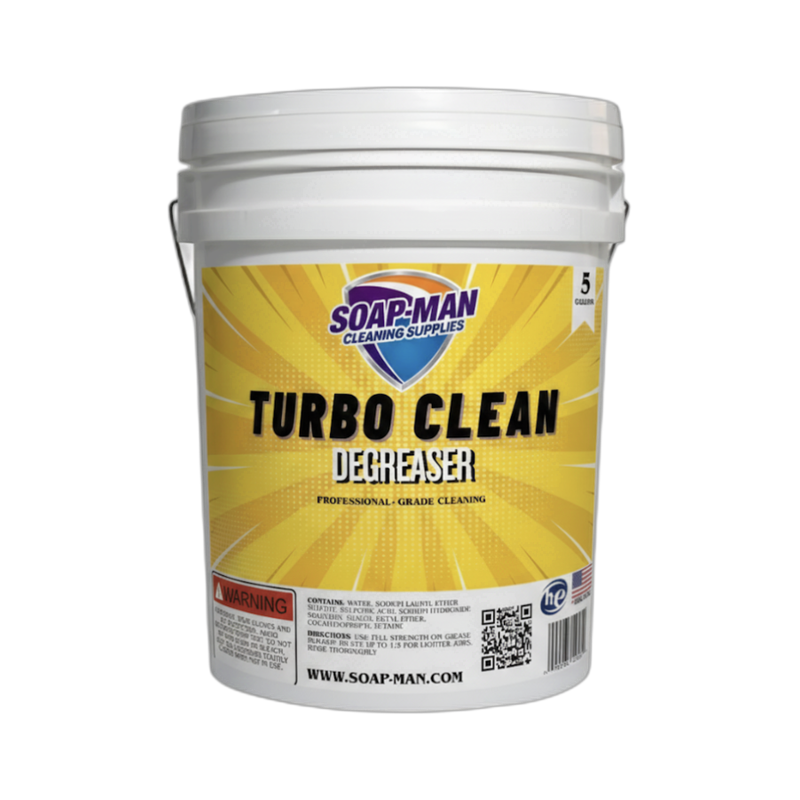
Floor finish is an acrylic polymer that is stable in the neutral-to-mildly-alkaline pH range (roughly 6 to 10). Strippers operate at pH 12 to 14 — high enough to break the polymer bonds. The problem: an alkaline degreaser sits at pH 12 to 13, only slightly below stripper territory. Turbo Clean Degreaser, used at full strength, will partially attack a floor finish if left to dwell. Used at proper dilution (1:32 or so), it is fine for daily mopping but should not be used at concentrate strength on a finished floor.
This is why it is critical to keep two separate buckets and two separate mops if you maintain a finished VCT floor: a daily-cleaning bucket with neutral or mildly alkaline cleaner, and a stripping bucket reserved for stripping operations. Crossing over destroys the finish prematurely.
When Each Product Belongs in Your Cleaning Program
Use Floor Wax (Finish) When You Are:
- Initial install of new VCT — apply 4 to 6 coats over the bare tile after the manufacturer's curing window (typically 14 days for most VCT brands)
- Recoating after a strip — 4 to 5 coats minimum after a full strip
- Adding 1 to 2 maintenance coats during a quarterly scrub-and-recoat
- Restoring gloss in high-traffic areas mid-cycle (spot recoat)
Use Floor Stripper When You Are:
- Removing 12+ months of accumulated finish that has yellowed or broken down
- Removing edge build-up that has formed visible ridges along walls
- Repairing a floor where finish has flaked or peeled in patches
- Resetting a floor that has been damaged by improper cleaning chemistry (acid spills, alkaline degreaser dwell, oil contamination)
Standard Stripping Procedure (OSHA-Compliant)
Stripping is the most chemically aggressive routine task in floor care, and it has the highest injury rate. OSHA HazCom 1910.1200 requires that the SDS for the stripper be on file and that operators be trained on the chemical hazards. Always wear chemical-resistant gloves, eye protection, and slip-resistant footwear. Post wet floor signs and rope off the area — alkaline strippers create extremely slippery surfaces.
- Remove all furniture, mats, and obstructions. Sweep and dust mop the floor thoroughly. Any soil left on the floor will combine with the dissolved finish and create a slurry that is harder to remove.
- Mix stripper at the manufacturer's recommended dilution. Most commercial strippers dilute 1:4 to 1:8 with cool water. Hot water flashes off ammonia in the stripper and reduces effectiveness — always cool water.
- Apply liberally with a string mop or stripper applicator. Do not skimp — under-application is the most common cause of stripping failure. The stripper needs to dwell wet on the surface to dissolve the finish.
- Dwell 5 to 10 minutes. Do not let the stripper dry on the floor. If it starts to dry, re-apply more stripper to the affected area. Dried stripper is significantly harder to remove than wet stripper.
- Agitate with a 175 RPM rotary machine and a stripping pad (typically black). Two passes minimum, with overlap. Edges and corners require manual scrubbing with a doodle bug or hand pad.
- Pick up the dissolved slurry with a wet vacuum or auto-scrubber. Mopping the slurry will only redistribute it.
- Rinse twice with clean water. Stripper residue left on the floor will neutralize the new finish and cause adhesion failure. Use a fresh mop and bucket for the rinse — never the stripping mop.
- Allow the floor to dry completely (typically 30 to 60 minutes) before applying finish. Moisture trapped under finish is the #1 cause of cloudy, hazy recoats.
For the recoat half of strip-and-recoat, see the floor-finish manufacturer's specific instructions. Most commercial finishes apply 4 to 5 thin coats with 30 minutes between coats. Apply the first 2 coats edge-to-edge; pull the last 2 coats back from the edges by 6 inches to prevent edge build-up that you will have to strip out next time.
What to Avoid (Common Mistakes That Destroy Floors)
- Stripping polished concrete or terrazzo. Strippers will etch unsealed polished concrete and damage the polish. Concrete and terrazzo use sealers and densifiers, not finish — different products entirely.
- Stripping luxury vinyl tile (LVT). Most LVT does not need finish at all — it has a factory-applied wear layer. Stripping LVT can damage the wear layer and shorten the floor's life by years.
- Using a degreaser as a stripper. Even a high-pH degreaser like Turbo Clean is not formulated for stripping — it lacks the specific solvents that break polymer bonds. You will dwell longer, achieve worse results, and risk substrate damage.
- Letting stripper dry on the floor. Dried stripper crystallizes and bonds to the substrate. Removing it requires heavy mechanical agitation that can damage the tile.
- Skipping the rinse step. Stripper residue (alkaline) reacts with the new finish (mildly alkaline) and prevents proper curing. Result: a finish that hazes within 30 days and has to be redone.
- Recoating over a contaminated or damaged finish. Adding new finish over old failure does not solve the problem; it just hides it for 60 to 90 days before the failure surfaces through the new coats.
Floor Care Cost Math
For a 10,000 sqft VCT floor on a typical 18-month strip cycle:
- Strip and recoat (annually or every 18 months): 60 to 80 labor-hours, $200 to $400 in stripper, $400 to $700 in finish. Total $1,200 to $2,500 depending on labor rate.
- Quarterly scrub and recoat (4x per year): 12 to 16 labor-hours each, $80 to $150 in finish each. Total $1,000 to $1,800 per year.
- Daily mopping with neutral or mildly alkaline cleaner: Roughly $0.0004 per sqft cleaned at proper dilution, so $4 per cleaning across 10,000 sqft.
The economics favor frequent burnishing and recoating over over-stripping. If your floors look bad mid-cycle, fix the burnish and recoat program before reaching for stripper.
Soap-Man and Floor Care
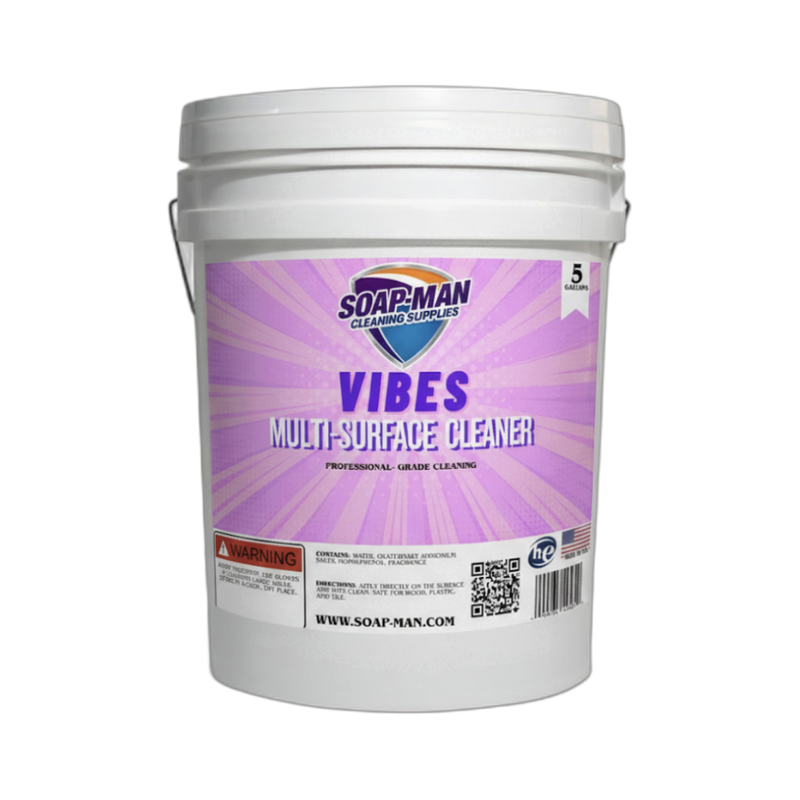
Soap-Man stocks commercial floor cleaners and degreasers for daily and weekly maintenance — the chemistry that keeps a finished floor in good shape between strip cycles. Vibes Multi-Surface Cleaner at proper dilution (1:64 for daily mopping) is safe on most finished VCT and tile floors. Turbo Clean Degreaser handles industrial floor cleaning where finish is not present (warehouses, loading docks, automotive bays). For strip-and-recoat operations, talk to our team at (908) 590-8562 for the right stripper-and-finish pairing — strippers are paired with specific finish chemistries, and a mismatch is one of the most common causes of recoat failure.
Browse the full degreasers and floor care category, see the commercial cleaning hub, or request a quote for facility-sized pricing.
Frequently Asked Questions
Is floor wax the same as floor finish?
In commercial cleaning, the terms are used interchangeably, though "finish" is technically more accurate. Modern commercial floor finishes are acrylic polymer emulsions, not actual wax. True wax (carnauba or paraffin) was used historically but has been largely replaced by acrylic finish because acrylics are harder, more durable, and have better gloss retention. When a vendor says "floor wax," they almost always mean acrylic floor finish.
How often should commercial floors be stripped?
For VCT and vinyl tile in moderate-traffic commercial settings, every 12 to 24 months. Heavy-traffic retail or schools may need annual stripping. Light-traffic offices can extend to every 24 months with proper interim burnishing and recoating. If your finish looks bad more often than that, the problem is usually under-burnishing or under-recoating between strip cycles, not a need to strip more frequently.
Can I use a high-pH degreaser to strip my floor?
No. While alkaline degreasers and floor strippers both operate at high pH, strippers contain specific solvents (typically butyl ethers or pyrrolidones) that break acrylic polymer bonds. Degreasers lack these solvents. Trying to strip with a degreaser produces incomplete results, requires extended dwell, and risks substrate damage from the prolonged alkaline exposure.
What pH is floor stripper?
Commercial floor strippers typically operate at pH 12 to 14. Some heavy-duty strippers reach pH 13.5 to 14. This high alkalinity is what dissolves the acrylic finish polymer. It is also why stripper requires PPE (chemical-resistant gloves, eye protection) and full rinsing — residual stripper at this pH will neutralize new finish and cause adhesion failure.
Can I strip and recoat in the same shift?
Yes, if the floor area is moderate (under 5,000 sqft) and you have at least 8 to 10 hours. The constraint is dry time: each coat of new finish requires 30 minutes minimum between coats, and the floor must be fully dry after rinsing before applying the first coat. A 5,000 sqft strip-and-recoat with 4 coats of finish runs roughly 6 to 8 hours by an experienced two-person team. Larger areas typically split across two shifts (strip Friday night, recoat Saturday).
Why does my newly recoated floor look hazy?
Three common causes: (1) inadequate rinse after stripping (alkaline residue neutralizing the finish), (2) applying finish over a damp floor (moisture trapped under coats), or (3) applying coats too thick (finish white-haze when it cures faster on the surface than in the depth of the coat). Fix by stripping again and applying thin, even coats over a fully rinsed and fully dried substrate.
Do polished concrete and luxury vinyl need stripper?
No. Polished concrete is densified and polished mechanically — there is no finish to strip. Maintenance is limited to neutral-pH daily cleaning and periodic re-densification or re-polishing by a specialty contractor. Luxury vinyl tile (LVT) has a factory-applied wear layer; most LVT manufacturers explicitly void the warranty if you apply finish or stripper. LVT maintenance is daily neutral cleaning and periodic spot-deep-cleaning.
What's the safest stripper for the operator?
Stripping is inherently chemical-aggressive — there is no truly low-risk stripper. Mid-pH solvent-blend strippers (sometimes marketed as "no-rinse" or "low-odor") reduce some of the operator-exposure risk versus traditional high-pH strippers but generally require longer dwell and more agitation. Whichever stripper you choose, follow OSHA 1910.1200 PPE requirements: chemical-resistant gloves (nitrile or butyl), splash-rated eye protection, and slip-resistant footwear. Post wet floor signs and rope off the work zone for the duration of the operation.