
To clean a Trex or composite deck, sweep off loose debris, rinse with a hose, then scrub each board with warm soapy water and a soft-bristle brush, working the suds into the embossing grooves. Rinse thoroughly so no film dries on the surface. That soap-and-water method is exactly what Trex itself recommends -- and unlike a wood deck, composite never needs sanding, staining, or sealing. The rest of this guide covers the stains soap and water will not lift, the mold problem unique to composite, and the one mistake that voids your warranty.
Composite decking is built from recycled wood fibers bonded with recycled plastic, which is why it resists rot, splinters, and fading far better than pressure-treated lumber. The category has exploded for exactly that reason: Grand View Research valued the global composite decking market at roughly $3.0 billion in 2023 and projects it will grow at around 13% annually through 2030 as more homeowners trade wood for low-maintenance boards (Grand View Research, Wood Plastic Composite Market, 2023). "Low-maintenance" is not "no-maintenance," though. Pollen, leaf tannins, grease from the grill, and shaded-side mold all still need attention -- and the wrong cleaner or too much pressure can permanently damage the surface and void the manufacturer warranty.
If you have a traditional wood deck instead, our companion guide on how to clean a deck without a pressure washer covers the grain-safe method for cedar, pine, and pressure-treated lumber. This guide is specifically for Trex, TimberTech, Fiberon, and other wood-plastic composite boards.
Wood Deck vs. Composite Deck: Why the Cleaning Is Different
Before you grab a brush, understand why composite cleans differently than the wood deck your neighbor has. Getting this wrong is how people scratch their boards or void a 25-year warranty.
- Composite has a capped or co-extruded shell. Most boards made after about 2013 have a hard polymer outer layer bonded over the wood-plastic core. That shell resists stains and fading -- but abrasive pads, wire brushes, and high pressure can scratch through it, exposing the softer core underneath.
- Composite is more porous in the embossing grooves. The wood-grain texture that makes composite look natural also traps pollen, dirt, and organic film -- the food source that mold grows on. Cleaning means getting suds down into those grooves, not just across the top.
- Composite never gets sanded, stained, or sealed. Trex explicitly states that sanding voids the warranty. Unlike wood, you are only ever cleaning the surface, never refinishing it.
- Composite has stain and fade warranties with conditions. Trex high-performance lines carry a 25-year (residential) or 50-year limited stain and fade warranty -- but food and grease stains must be cleaned within a set window to stay covered (more on that below).
What You Need to Clean Composite Decking
The right tools prevent the scratches and chemical damage that ruin a composite finish. You do not need anything specialized -- you almost certainly own most of this already.
Cleaning Tools
- Soft-bristle brush or broom -- nylon or synthetic bristles on a long handle. Never use a wire brush or a stiff metal-bristled deck brush; both scratch the composite shell.
- Garden hose with a spray nozzle -- for pre-rinsing and final rinsing. A standard hose stream is all most composite cleaning needs.
- Bucket -- for mixing your soap-and-water solution.
- Plastic snow shovel -- if you live in a cold climate. Trex warns that a metal snow shovel can scratch the deck, and that scratch is not covered under warranty.
- Leaf blower (optional) -- the fastest way to clear loose debris and dry the surface after rinsing to prevent water spots.
- Tarp or plastic sheeting -- to protect nearby plants and landscaping from cleaner runoff.
Cleaning Solutions
- Warm soapy water -- mild dish soap or a gentle all-purpose cleaner in warm water handles the vast majority of routine composite cleaning. Trex names "warm, soapy water and a soft bristle brush" as its standard recommendation for dirt, debris, food, and mold.
- A mild all-purpose / multi-surface cleaner -- for a deeper routine clean. Soap-Man's Vibes Multi-Surface Cleaner is a mildly alkaline, streak-free, residue-free formula that dilutes 1:32 to 1:64, so one gallon makes up to 64 gallons of working solution. It rinses clean off composite without leaving the film that attracts new dirt.
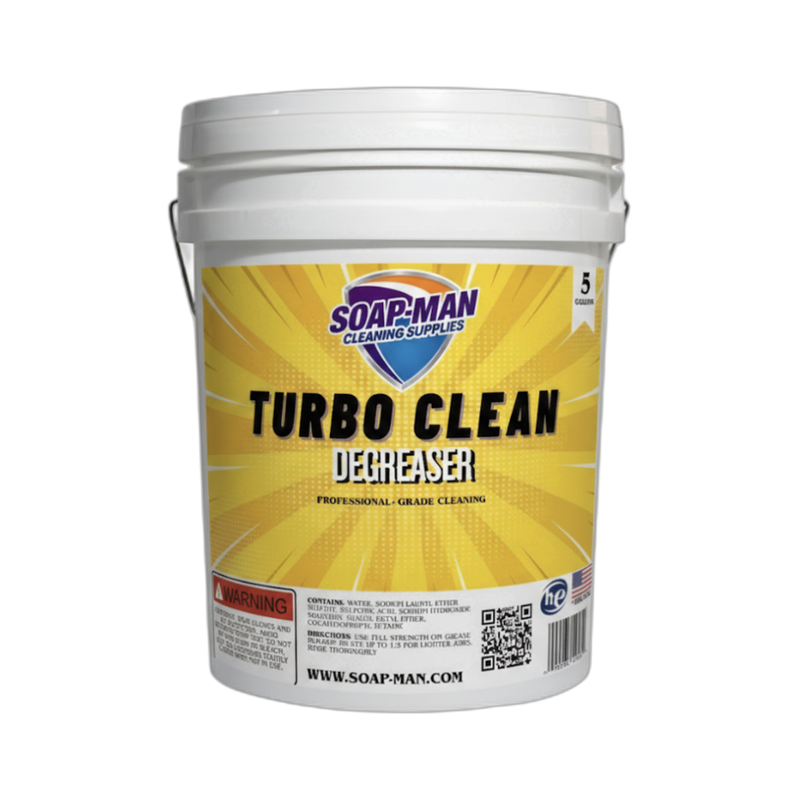
- A degreaser for grease and grill stains -- food, cooking grease, and barbecue splatter need more than dish soap. Turbo Clean Degreaser, diluted and used as a spot treatment, lifts petroleum and cooking-grease stains. Always rinse fully and test a hidden area first, since composite color can be sensitive to strong spot treatments.
- A deck brightener containing oxalic acid -- the manufacturer-recommended treatment for leaf tannins, rust stains, and ground-in pigment. This is a specialty product, not your everyday cleaner.
- White vinegar (diluted) -- useful only for hard-water mineral spots and as a mild mold treatment. It is a spot tool, never a routine cleaner, and it should always be rinsed off.
How to Clean a Trex or Composite Deck: The 5-Step Method
This is the routine clean that handles 90% of what a composite deck needs. Do it at least twice a year -- spring and fall -- and after any big mess. Work in the shade if you can; direct sun dries the cleaner too fast and leaves streaks.
- Clear and sweep the deck. Remove furniture, planters, the grill, and the doormat. Sweep off leaves, pollen, and dirt, paying special attention to the gaps between boards where debris collects. Trapped debris in the gaps is the number-one cause of mold, because it holds moisture against the boards and feeds the biofilm mold grows on.
- Pre-rinse with a hose. Spray the whole deck with plain water to flush surface debris and wet the boards so the cleaner spreads evenly instead of soaking in unevenly.
- Apply warm soapy water and scrub. Mix mild soap or a multi-surface cleaner with warm water. Working one section at a time, spray or pour the solution on and scrub each board lengthwise with a soft-bristle brush. Follow the direction of the grain pattern and work the suds down into the embossing grooves where dirt and mold hide.
- Rinse thoroughly. Rinse each section with clean water before the soapy water dries. Trex is explicit on this point: "If dirty water from cleaning is left to dry, a film will remain on the decking surface." That film dulls the boards and traps new dirt, so over-rinse rather than under-rinse.
- Let it dry. Allow the deck to air-dry, or speed it up with a leaf blower to prevent water spots. Once dry, replace your furniture and you are done.
For a standard backyard deck this takes 45 minutes to an hour. There is no sanding, staining, or sealing step -- that is the entire payoff of going composite.
How to Remove Mold and Mildew From Composite Decking
Mold is the single most common composite-deck complaint, and it is worse on shaded, north-facing, or tree-covered decks. Here is the part most homeowners get wrong: mold does not eat the composite itself. It feeds on the biofilm of pollen, dirt, and organic debris that settles on the surface. Trex's own mold technical bulletin makes this clear -- remove the food source and you remove the mold.
That matters for your health, too. The U.S. Centers for Disease Control and Prevention notes that damp, moldy surfaces can trigger stuffy nose, wheezing, and eye or skin irritation, and more serious reactions in people with asthma or mold allergies (CDC, About Mold). A slippery, mold-coated deck is also a fall hazard. The U.S. Environmental Protection Agency adds that the key to mold control is moisture control -- fix the wet, shaded conditions and mold cannot return (EPA, Mold Cleanup in Your Home).
To remove mold and mildew from composite decking:
- Sweep and pre-rinse to clear the loose debris that feeds the mold.
- Treat the mold. For light mold, warm soapy water and a soft-bristle brush is the manufacturer-preferred method. For heavier mildew, a common homeowner approach is a solution of one part white vinegar to two parts water, sprinkled with baking soda and left to sit about 20 minutes before scrubbing. Vinegar is a spot treatment only -- never a routine cleaner.
- Scrub down into the grooves with the soft-bristle brush. Mold lives in the textured embossing, not on the smooth high points.
- Rinse thoroughly with clean water and let the deck dry fully.
- Prevent the comeback. Keep the gaps between boards clear so air circulates and water drains, trim back overhanging branches to let sunlight reach the deck, and do not leave wet leaves or a rubber-backed mat sitting on the surface.
Do not use chlorine bleach as a routine mold cleaner on composite. Trex warns that products containing bleach or acid will lighten the surface, so if you ever use one, test an inconspicuous spot first. An oxygenated (oxygen-bleach) cleaner is the gentler choice when soap and water is not enough.
Stain Removal Guide: The 5 Most Common Composite Deck Stains
Soap and water handles everyday dirt, but these specific stains need targeted treatment. The methods below follow Trex's published care guidance.
Grease, Oil, and Food (Barbecue Season)
Grill splatter and food spills are the summer stain. The critical detail almost no one knows: Trex requires food spills to be cleaned within seven days to keep the stain warranty valid. Do not let that burger grease sit.
- Rinse the spot with hot water as soon as possible.
- Apply warm soapy water and scrub the embossing pattern with a soft-bristle brush.
- For stubborn grease, spot-treat with a diluted degreaser like Turbo Clean Degreaser, test a hidden area first, then rinse completely.
- Prevention: put a grill mat under the barbecue -- but choose one without a rubber backing, because rubber-backed mats can discolor composite over time.
Leaf Tannins and Water Stains
Wet leaves, acorns, and pine needles leave brown tannin stains as they decompose. Tannin leaching is natural on wood-based products and often fades on its own after about 12 weeks of weathering.
- Remove all debris and rinse the deck.
- Once dry, apply a deck brightener containing oxalic acid as directed by its manufacturer. Oxalic acid is the chemistry that specifically lifts tannins.
- Rinse thoroughly and let dry.
- Prevention: sweep leaves promptly during fall and do not let piles sit on the boards.
Rust and Ground-In Dirt
Rust comes from metal furniture feet, planters, and grill legs. Ground-in pigment comes from foot traffic and tracked-in soil.
- Use a deck-brightener product with an oxalic- or phosphoric-acid base. Let it dwell 10 to 15 minutes per the label, then rinse.
- Prevention: place plastic or composite-safe glides under metal furniture legs.
Hard-Water and Sprinkler Spots
Hard water leaves white mineral deposits of lime, silica, and calcium when it evaporates. This is a water-quality issue, not a deck defect.
- Spot-treat the deposits with white vinegar, then rinse with clean (ideally non-hard) water. If you must rinse with hard water, dry the surface with a cloth or leaf blower so new spots do not form.
- A deck-brightener product can also lift heavier hard-water staining.
- Prevention: aim lawn sprinklers away from the deck.
Ice, Snow, and Winter De-Icer
Composite handles winter well, but the wrong tools cause warranty-voiding scratches.
- Use calcium chloride or rock salt to melt ice on composite decking, then rinse off when practical.
- Use a plastic snow shovel only. Trex states a metal shovel may scratch the deck, and that damage is not covered under warranty.
- Rinse de-icer residue away in spring as part of your first deep clean of the season.
Can You Pressure Wash Composite Decking? The 3,100 PSI Rule
Yes -- but with strict limits, and this is where homeowners void warranties. Trex permits a pressure washer on its high-performance lines (Transcend, Enhance, Select) only under specific conditions:
- Stay at or below 3,100 PSI. Trex states that a pressure washer greater than 3,100 PSI could damage the boards and void the warranty.
- Use a fan tip, never a zero-degree (red) tip. A concentrated stream gouges the composite shell.
- Keep the nozzle at least 8 inches from the surface. Use the soap dispenser, spray, gently scrub each board with a soft brush, then rinse each board individually.
- Rinse thoroughly so no dirty-water film dries on the boards.
One major exception: early-generation composite (uncapped boards, generally pre-2013) should never be pressure washed. Trex does not recommend a pressure washer on early-generation decking, and using one voids the warranty for any damage it causes. If you are not certain which generation your boards are, skip the pressure washer entirely -- soap, water, and a soft brush always work and never void anything. For the full grain-safe, no-pressure-washer routine, see our guide on cleaning a deck without a pressure washer.
What to Never Use on Composite Decking
The wrong product or tool causes permanent damage and can void your warranty. Avoid all of these:
- Wire brushes, steel wool, and abrasive scouring pads -- they scratch through the protective composite shell into the softer core.
- Metal snow shovels and metal scrapers -- guaranteed scratches that are not warranty-covered.
- Sandpaper or any sanding -- Trex states sanding changes the surface appearance and voids the warranty. Composite is never refinished.
- Chlorine bleach as a routine cleaner -- it lightens the surface color. Reserve it for a tested spot treatment at most, and prefer oxygen bleach.
- Acetone and solvents on railing -- Trex says never use acetone or solvents on Transcend and Select railing.
- Rubber-backed mats and vinyl planters left in place -- additives in rubber and PVC migrate into composite over time and discolor it.
- Pressure washers above 3,100 PSI, zero-degree tips, or any pressure washer on early-generation boards -- the fastest way to void a composite warranty.
Seasonal Composite Deck Maintenance Schedule
Composite is low-maintenance, not maintenance-free. This schedule keeps the warranty valid and the boards looking new.
- Spring: Do a full soap-and-water deep clean to remove winter grime, pollen, and de-icer residue. Inspect for mold on shaded sides and clear the gaps between boards.
- Summer: Spot-clean grill grease and food spills within seven days to protect the stain warranty. Sweep pollen and rinse as needed during heavy-use months.
- Fall: Sweep leaves promptly and do not let them pile up -- this prevents tannin stains and mold. Do a second full clean before winter.
- Winter: Use calcium chloride or rock salt for ice, a plastic shovel for snow, and never a metal blade.
- Twice a year minimum: Trex recommends a semi-annual cleaning, especially for early-generation boards, to stop pollen and biofilm from feeding mold.
The Best Cleaner for Composite Decking
The "best" composite cleaner is the gentlest one that still does the job. For routine cleaning, warm soapy water or a mild, streak-free multi-surface cleaner is all you need -- aggressive chemistry only risks lightening the color. Save the heavy degreaser and oxalic-acid brightener for targeted stains.
- Vibes Multi-Surface Cleaner -- a mild, streak-free, residue-free formula for routine composite cleaning. Dilutes 1:32 to 1:64, so one gallon makes up to 64 gallons of working solution. Rinses clean without leaving a film that attracts new dirt.
- Turbo Clean Degreaser -- a heavy-duty degreaser for grill grease, oil, and food stains. Use diluted as a spot treatment, test a hidden area first, and rinse completely.
Both are available in 1-gallon and 5-gallon sizes with volume discounts starting at 6 units. Request a free quote or call (908) 590-8562 for bulk pricing. Free delivery on orders over $500.
Frequently Asked Questions
Can I use Dawn dish soap on Trex decking?
Yes. Mild dish soap like Dawn mixed with warm water is safe for Trex and other composite decking and is essentially the manufacturer-recommended method. Spray or pour the soapy water on, scrub each board with a soft-bristle brush, and rinse thoroughly so no soap film dries on the surface. For a deeper clean, a mild multi-surface cleaner works the same way.
What should you not use on Trex decking?
Avoid wire brushes, steel wool, abrasive pads, metal snow shovels, sandpaper, acetone or solvents on railing, and chlorine bleach as a routine cleaner. Do not pressure wash above 3,100 PSI, never use a zero-degree tip, and never pressure wash early-generation (uncapped) Trex boards. Rubber-backed mats and vinyl planters left in place can also discolor the surface over time.
How do you make Trex decking look new again?
Do a full soap-and-water clean: sweep, pre-rinse, scrub each board with warm soapy water and a soft-bristle brush working into the embossing grooves, then rinse thoroughly. For leftover tannin, rust, or hard-water stains, apply a deck brightener containing oxalic acid as directed. Trex is never sanded, stained, or sealed -- a thorough cleaning is what restores its appearance.
Can I use a pressure washer on composite decking?
Only on capped, high-performance composite (such as Trex Transcend, Enhance, or Select) and only at 3,100 PSI or lower, with a fan tip held at least 8 inches from the surface, using the soap dispenser and a soft brush. Pressure above 3,100 PSI, a zero-degree tip, or any pressure washing on early-generation (uncapped) boards can damage the deck and void the warranty.
How do you get mold off composite decking?
Mold feeds on the pollen and dirt biofilm on the surface, not the composite itself, so removing that debris removes the mold. Sweep and rinse, then scrub with warm soapy water and a soft-bristle brush down into the grooves. For heavier mildew, a diluted vinegar-and-water spot treatment with baking soda works, but rinse it off. Keep board gaps clear and let sunlight reach the deck to stop mold from coming back.
How often should you clean a composite deck?
Clean a composite deck at least twice a year -- a deep clean in spring and again in fall -- plus prompt spot-cleaning of grease, food, and leaf debris as they happen. Trex recommends semi-annual cleaning, and early-generation boards especially benefit from it because regular cleaning removes the biofilm that feeds mold.
Does cleaning Trex decking the wrong way void the warranty?
It can. Pressure washing above 3,100 PSI, pressure washing early-generation boards, sanding, and scratches from metal tools are all called out by Trex as warranty-voiding. Food and grease stains also must be cleaned within seven days to keep the stain warranty valid. Sticking to soap, water, and a soft-bristle brush keeps you fully within warranty.
Is vinegar safe on composite decking?
Vinegar is safe as an occasional spot treatment for hard-water mineral spots and light mildew, but it should never be your routine cleaner and should always be rinsed off. Trex notes that acidic products can lighten the surface, so test an inconspicuous area first. For everyday cleaning, use warm soapy water or a mild multi-surface cleaner instead.