
Janitorial supplies are the cleaning chemicals, tools, paper products, and equipment that businesses use to maintain clean, safe, and professional environments. Whether you manage an office building, a restaurant, a medical facility, or a warehouse, the right janitorial supplies keep your space healthy for employees and customers while meeting health code and OSHA requirements.
This guide covers exactly what you need, how to choose it, and how to save money buying it. We wrote it because most businesses overspend on janitorial supplies by 20-40% simply because they buy retail instead of wholesale, purchase ready-to-use when concentrates would save thousands annually, or stock products they do not actually need.
Soap-Man Cleaning Supplies has been providing commercial-grade janitorial products to businesses across New Jersey, New York, Pennsylvania, and the entire East Coast. We deliver bulk cleaning supplies directly to your facility with free delivery on orders over $500.
What Are Janitorial Supplies?
Janitorial supplies encompass every product a facility needs for daily cleaning and maintenance. The term covers six major categories: cleaning chemicals and solutions, paper products and dispensers, mops and floor care equipment, trash bags and waste management, restroom and hygiene supplies, and safety and protective equipment.
The distinction between janitorial supplies and household cleaning products is important. Commercial janitorial products are formulated at higher concentrations, sold in larger quantities, and designed for repeated daily use across large areas. A gallon of commercial-grade multi-surface cleaner concentrate can produce 30 to 60 gallons of working solution, while a retail spray bottle from a big-box store covers a single kitchen. The per-use cost difference is dramatic: commercial concentrates typically cost $0.02 to $0.08 per diluted ounce versus $0.15 to $0.30 per ounce for retail ready-to-use sprays.
Essential Janitorial Supplies Checklist
Every commercial facility needs supplies from each of these six categories. The specific products vary by industry, but the categories are universal.
Cleaning Chemicals and Solutions
Cleaning chemicals form the backbone of any janitorial program. At minimum, every facility needs these five types of chemical products:
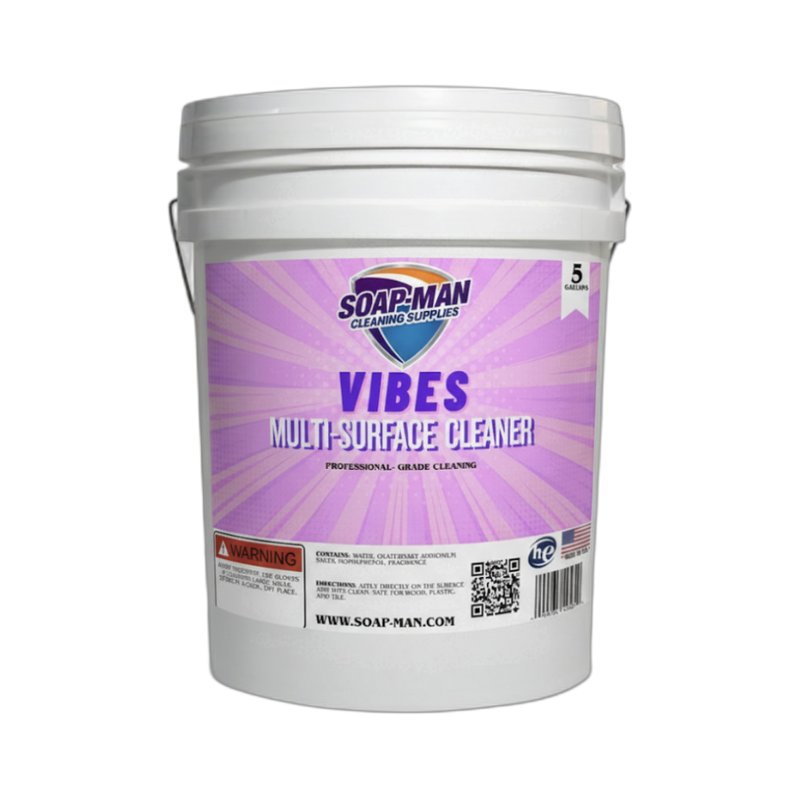
- Multi-surface cleaner -- handles countertops, desks, tables, glass, and general hard surfaces. Look for a concentrate with a dilution range of 1:32 to 1:64 for maximum versatility. Soap-Man's Vibes Multi-Surface Cleaner covers this category at a cost of roughly $0.03 per diluted ounce.
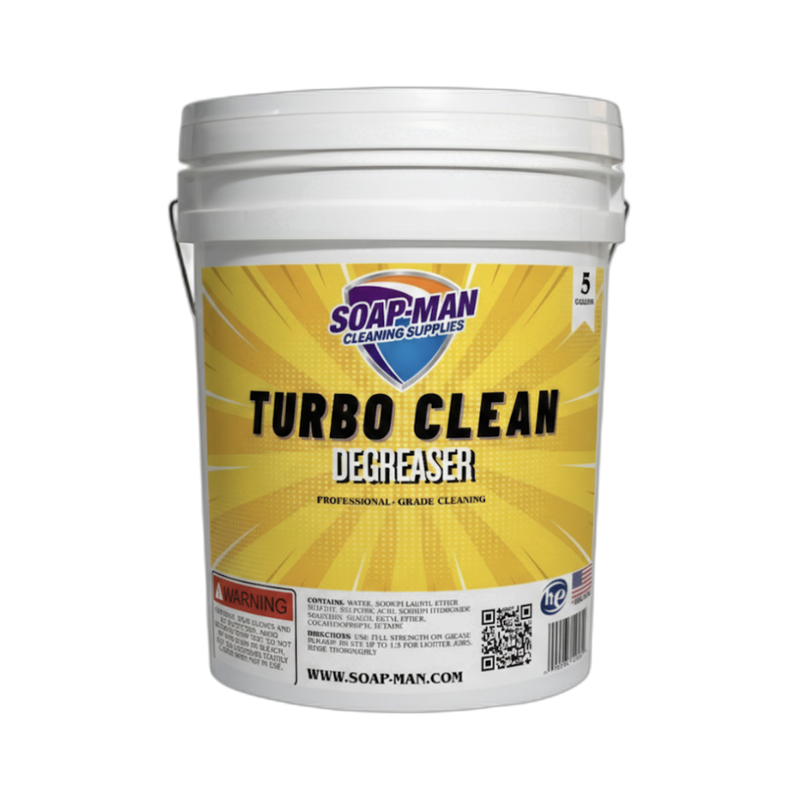
- Degreaser -- essential for kitchens, break rooms, and any space where grease accumulates. Commercial degreasers like Turbo Clean Degreaser operate at a pH of 12 to 13, cutting through cooking grease and petroleum-based oils that all-purpose cleaners cannot handle.
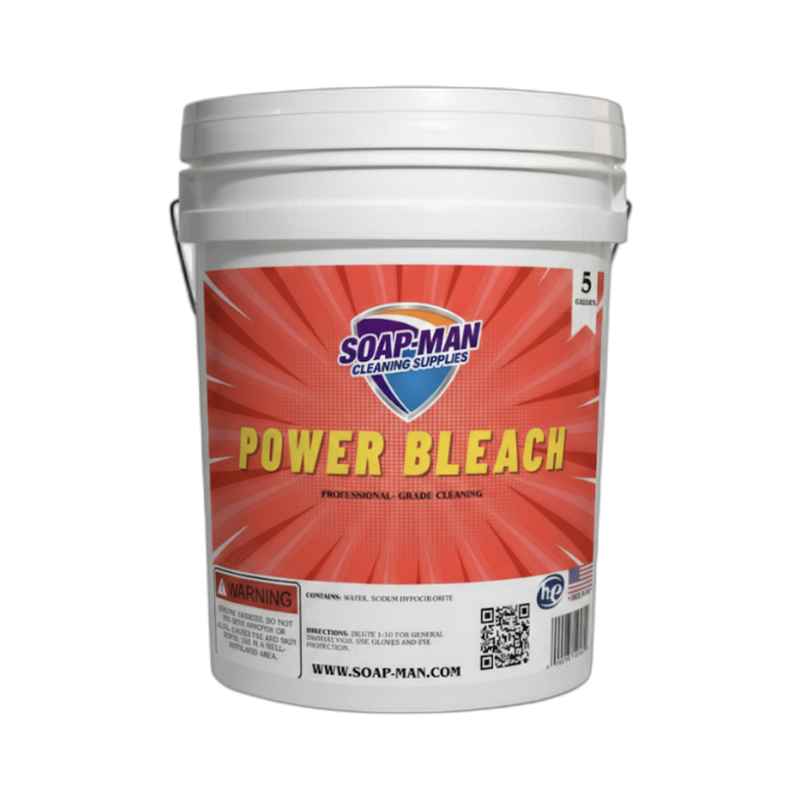
- Disinfectant or bleach -- required for restrooms, healthcare settings, food prep areas, and any high-touch surfaces. EPA-registered disinfectants must list specific organisms they kill on the label. Power Bleach provides broad-spectrum disinfection at commercial strength.
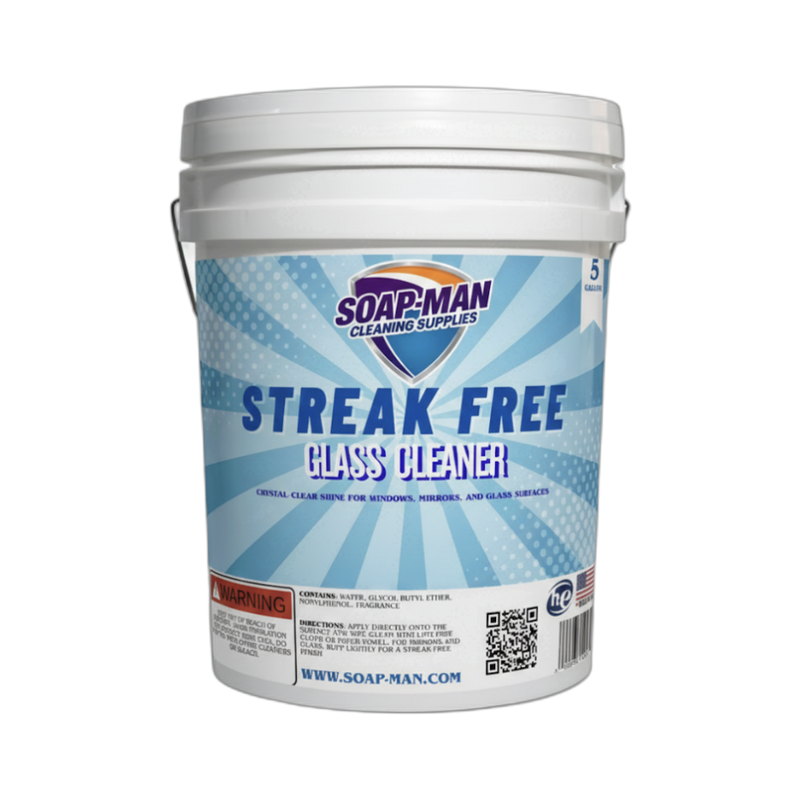
- Glass cleaner -- dedicated glass cleaner prevents the streaking and hazing that multi-surface cleaners leave on windows and mirrors. Ammonia-free formulas like Streak Free Glass Cleaner are safer for tinted glass and anti-reflective coatings.
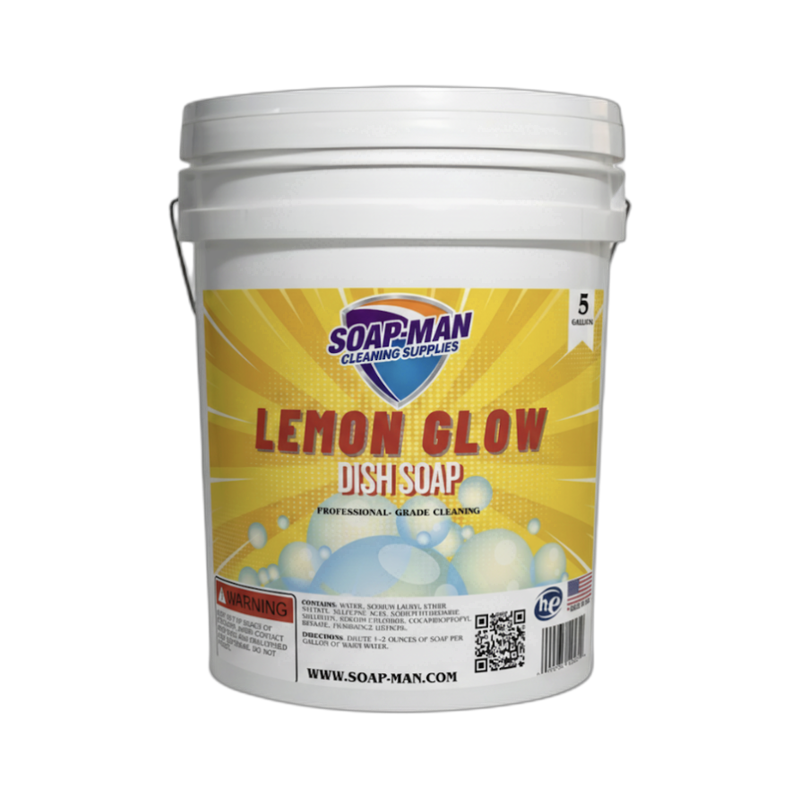
- Dish soap or food service cleaner -- for any facility with a kitchen or break room. Lemon Glow Dish Soap handles commercial dish volume without leaving residue.
Beyond these five essentials, many facilities also need floor finish, floor stripper, carpet shampoo, stainless steel cleaner, and specialty degreasers for specific equipment.
Paper Products and Dispensers
Paper products are the highest-volume consumable in most janitorial programs. Plan to stock:
- Paper towels -- multifold, C-fold, or roll towels depending on your dispenser type. Commercial dispensers reduce waste by 30-50% compared to loose towel stacks.
- Toilet paper -- jumbo rolls for commercial dispensers last 3-5 times longer than standard household rolls, reducing changeout frequency.
- Facial tissue -- for offices, reception areas, and conference rooms.
- Seat covers -- standard in commercial restrooms for hygiene and customer comfort.
- Dispensers -- wall-mounted dispensers for towels, soap, and toilet paper. Choose lockable dispensers to prevent theft and ensure consistent presentation.
Mops, Brooms, and Floor Care
Floor care consumes the largest portion of most janitorial time budgets. Essential floor care supplies include:
- Wet mop system -- a mop bucket with wringer and at least two mop heads (one in use, one drying or being laundered). Microfiber mops clean more effectively and last longer than cotton string mops.
- Dust mop -- for daily sweeping of hard floors. Dust mops capture fine particles that brooms push around. A 36-inch dust mop covers corridors and open spaces efficiently.
- Broom and dustpan -- for spot sweeping and areas a dust mop cannot reach (corners, edges, stairs).
- Floor cleaner or finish -- matched to your floor type. VCT, hardwood, concrete, and tile each require different chemical formulations.
- Floor pads and scrub brushes -- for periodic deep cleaning. Color-coded pads indicate aggressiveness: white (polishing), red (light scrub), blue (medium scrub), green (heavy scrub), black (stripping).
Trash Bags and Waste Management
The right trash bag prevents tears, leaks, and double-bagging waste. Choose bags based on:
- Gallon capacity -- match the bag size to your can. Common sizes are 7-10 gallon (office wastebaskets), 23 gallon (slim jim cans), 33 gallon (standard cans), and 55-60 gallon (large bins).
- Mil thickness -- 0.5 mil for light office waste, 0.7 to 1.0 mil for break rooms and mixed waste, 1.2 to 2.0 mil for heavy or sharp waste.
- Can liners vs. contractor bags -- can liners are sized to fit specific receptacles, while contractor bags are oversized for construction or heavy cleanout work.
Restroom and Hygiene Supplies
Restroom supplies directly impact how customers and employees perceive your facility. Essential items:
- Hand soap -- foaming soap dispensers use 40% less soap per wash than liquid dispensers while providing the same cleaning effectiveness.
- Hand sanitizer -- wall-mounted or freestanding dispensers at building entrances, break rooms, and high-traffic areas. FDA-compliant sanitizers contain at least 60% ethanol or 70% isopropanol.
- Air freshener -- metered aerosol dispensers, gel cups, or fan-based systems. Avoid simply masking odors; choose products that neutralize odor molecules.
- Urinal screens and toilet bowl cleaner -- enzyme-based urinal screens reduce odor and prevent drain clogs between deep cleanings.
Safety and Protective Equipment
OSHA requires employers to provide personal protective equipment for cleaning staff. Standard janitorial PPE includes:
- Nitrile gloves -- chemical-resistant and latex-free. Stock multiple sizes.
- Wet floor signs -- bilingual (English/Spanish) caution signs are legally required during and immediately after mopping.
- Safety data sheets (SDS) -- every chemical product must have an accessible SDS binder. This is an OSHA requirement, not optional.
- Eye protection -- splash goggles for handling concentrates, mixing solutions, and stripping floors.
Janitorial Supplies by Industry
Different facilities have different supply needs. Here is what each industry type typically requires beyond the essentials listed above.
Office and Corporate Facilities
Offices consume the most paper products and the least chemical volume. A 10,000-square-foot office typically spends $300 to $600 per month on janitorial supplies. Key needs include multi-surface cleaner, glass cleaner, paper towels, toilet paper, hand soap, trash bags (mostly light-duty 7-10 gallon), and dust mop supplies. Offices rarely need heavy degreasers or industrial floor chemicals unless they have a kitchen or cafeteria.
Restaurants and Food Service
Restaurants have the most demanding janitorial requirements due to health department regulations. Monthly supply costs typically run $500 to $1,200 depending on size. Beyond standard supplies, restaurants need commercial degreasers for hoods and grills, food-safe sanitizer for prep surfaces, grease trap treatment, dish machine detergent and rinse aid, and floor cleaner rated for commercial kitchen tile. All chemicals must be stored separately from food per FDA Food Code requirements.
Healthcare and Medical Facilities
Healthcare facilities require EPA-registered hospital-grade disinfectants with specific kill claims for bloodborne pathogens, MRSA, C. diff, and other healthcare-associated infection organisms. Monthly costs range from $800 to $2,000 or more. Additional needs include biohazard bags and sharps containers, medical-grade hand sanitizer, microfiber cloths with color-coding systems to prevent cross-contamination, and HEPA-filtered vacuums for patient areas.
Schools and Educational Buildings
Schools need child-safe cleaning products -- many districts mandate Green Seal or EPA Safer Choice certified chemicals. Monthly budgets typically run $400 to $900. Schools also use high volumes of paper products (restrooms see heavy use during passing periods) and need gym floor finish, cafeteria degreasers, and anti-graffiti cleaners for restroom stalls and exterior surfaces.
Warehouses and Industrial Spaces
Warehouses and manufacturing facilities prioritize floor care and safety compliance. Monthly costs vary widely from $200 to $1,500 depending on size and operations. Key needs include industrial degreasers for concrete floors, floor sweep compound for dust control, heavy-duty trash bags (1.5 to 2.0 mil), spill containment supplies, and large-format paper towel rolls for shop use.
How to Choose the Right Janitorial Supplies
Concentrate vs. Ready-to-Use: Which Saves More
Concentrates save 50-75% compared to ready-to-use (RTU) products for any facility cleaning more than a few hundred square feet daily. Here is the math:
| Format | Purchase Price | Usable Volume | Cost Per Diluted Gallon |
|---|---|---|---|
| RTU spray bottle (32 oz) | $4.99 | 0.25 gallons | $19.96 |
| 1-gallon concentrate (1:32) | $18.99 | 32 gallons | $0.59 |
| 5-gallon concentrate (1:32) | $69.99 | 160 gallons | $0.44 |
A facility using 10 gallons of working solution per week would spend $10,378 annually on RTU spray bottles versus $305 on 5-gallon concentrate. That is a savings of over $10,000 per year on a single product category. Multiply that across five or six chemical types and the annual savings from switching to concentrates easily reaches $30,000 to $50,000 for a mid-size facility.
The only scenario where RTU makes sense is for very small spaces (a single office restroom, a personal workspace) where the convenience outweighs the cost difference.
What to Look for in a Janitorial Supplier
Not all janitorial suppliers are equal. The right supplier saves you time and money beyond just product pricing:
- Bulk pricing with volume discounts -- pricing should drop as your order size increases. At Soap-Man, volume discounts start at just 6 units.
- Delivery service -- hauling cases of chemicals from a retail store wastes your staff's time. Look for a supplier that delivers to your door. Soap-Man provides free delivery on orders over $500 across the East Coast.
- Recurring order programs -- set-it-and-forget-it delivery schedules prevent stockouts and reduce reordering labor. We offer weekly, bi-weekly, and monthly delivery schedules.
- Technical support -- when you need help choosing the right product for a specific surface or application, your supplier should be able to advise. Big-box store employees rarely have this expertise.
- Consistent stock -- nothing disrupts a cleaning program like your supplier being out of a product you depend on. Commercial suppliers maintain deeper inventory than retail stores.
Bulk Buying: When It Saves Money (and When It Doesn't)
Buying in bulk saves money on products you use consistently and that have a long shelf life. Cleaning chemicals, paper products, trash bags, and gloves are ideal bulk purchases because they do not expire quickly and usage is predictable.
Bulk buying does NOT save money when you are guessing at quantities, buying specialty products you use rarely, or when the product has a limited shelf life (some sanitizers and disinfectants lose potency after 12 to 18 months). Start with a 30-day supply calculation, then order in quantities that match 60 to 90 days of use for the best combination of savings and freshness.
Janitorial Supply Pricing Guide 2026
Pricing varies significantly between retail and wholesale sources. Here are typical 2026 price ranges for common janitorial supplies:
| Supply Category | Retail Price | Wholesale/Bulk Price | Savings |
|---|---|---|---|
| Multi-surface cleaner (per gallon concentrate) | $12 - $25 | $5 - $15 | 30 - 50% |
| Disinfectant/bleach (per gallon) | $8 - $18 | $4 - $10 | 35 - 55% |
| Degreaser (per gallon concentrate) | $15 - $30 | $8 - $18 | 30 - 45% |
| Paper towels (per case) | $35 - $60 | $20 - $40 | 30 - 40% |
| Toilet paper (jumbo rolls, per case) | $40 - $70 | $25 - $45 | 35 - 40% |
| Trash bags (per case of 100-250) | $20 - $50 | $12 - $30 | 30 - 40% |
| Nitrile gloves (per case of 1000) | $60 - $100 | $35 - $65 | 35 - 45% |
| Mop heads (per dozen) | $40 - $80 | $25 - $50 | 30 - 40% |
These ranges reflect typical 2026 market pricing for commercial-grade products. Actual prices depend on brand, quantity, and supplier. Request a custom quote from Soap-Man for pricing specific to your facility's needs.
How to Save Money on Janitorial Supplies
Businesses that follow these five practices consistently save 20-40% on their annual janitorial supply costs:
- Switch from retail to a commercial supplier. This single change typically saves 30% or more. You are paying a premium every time you buy cleaning products from a big-box store or online retailer that primarily serves consumers.
- Buy concentrates, not ready-to-use. As the table above shows, concentrates cost 95% less per diluted gallon. Invest $50 in a proportioning dispenser or spray bottle dilution system and the savings pay for the equipment on the first order.
- Consolidate vendors. Using one supplier for all your janitorial needs means larger orders, which means better volume pricing. It also simplifies receiving, invoicing, and inventory management.
- Set up recurring deliveries. Recurring orders eliminate emergency rush purchases (which always cost more) and ensure you always get the best price tier. Soap-Man offers scheduled weekly, bi-weekly, and monthly delivery programs.
- Train your staff on proper dilution and usage. Overusing chemicals is the most common waste in any cleaning program. A cleaning technician who pours half a cup of concentrate into a mop bucket instead of the recommended two ounces is wasting 75% of your chemical budget on every mopping session. Dilution control systems pay for themselves within months.
Why Businesses Choose Soap-Man for Janitorial Supplies
Soap-Man Cleaning Supplies serves businesses across the East Coast from New Jersey to Virginia. Here is what makes us different from big-box stores, Amazon, or national janitorial distributors:
- Commercial-grade products only. Everything we sell is formulated for professional use, not watered-down consumer versions repackaged in bigger bottles. Our product catalog includes detergents, degreasers, disinfectants, glass cleaners, dish soap, car care products, and fabric softeners -- all at professional concentrations.
- Bulk pricing with volume discounts starting at 6 units. No minimum order requirements for most products, but the more you buy, the less you pay per unit. Save up to 40% at pallet quantities.
- Free delivery on orders over $500. We deliver directly to your facility across NJ, NY, PA, MD, CT, DE, VA, MA, RI, and Washington DC. Same-day delivery available for orders placed before 12 PM.
- Recurring order programs. Set your schedule -- weekly, bi-weekly, or monthly -- and never worry about running out of supplies or remembering to reorder.
- Real people who know cleaning. When you call (908) 590-8562, you talk to someone who can recommend the right product for your specific application. Not a chatbot, not a call center -- a cleaning supply professional.
Ready to switch from overpriced retail supplies to wholesale commercial pricing? Request a free quote or contact our team to discuss your facility's needs.
Frequently Asked Questions About Janitorial Supplies
What janitorial supplies do I need for my business?
Every business needs six categories of janitorial supplies: cleaning chemicals (multi-surface cleaner, disinfectant, degreaser, glass cleaner), paper products (paper towels, toilet paper), mops and floor care equipment, trash bags, restroom supplies (hand soap, sanitizer), and safety equipment (gloves, wet floor signs). The specific products within each category depend on your industry and facility size. An office may spend $300 to $600 per month while a restaurant typically spends $500 to $1,200.
Where can I buy janitorial supplies in bulk?
Commercial janitorial suppliers like Soap-Man offer bulk pricing that saves 30-50% over retail stores like Home Depot or Walmart. Soap-Man delivers bulk cleaning supplies across the East Coast with free delivery on orders over $500. You can browse our product catalog online or call (908) 590-8562 for custom pricing.
What is the difference between commercial and consumer cleaning products?
Commercial cleaning products are formulated at higher concentrations, sold in larger quantities, and designed for repeated daily use across large areas. A gallon of commercial concentrate can produce 30 to 60 gallons of working solution, costing $0.02 to $0.08 per diluted ounce. Consumer products are ready-to-use sprays that cost $0.15 to $0.30 per ounce. The active ingredient concentrations in commercial products are typically 2 to 5 times higher than consumer versions.
How much do janitorial supplies cost per month?
Monthly janitorial supply costs vary by facility type and size. Typical ranges are: offices ($300 to $600), restaurants ($500 to $1,200), healthcare facilities ($800 to $2,000), schools ($400 to $900), and warehouses ($200 to $1,500). Switching from retail to wholesale purchasing typically reduces these costs by 30-40%.
Should I buy concentrate or ready-to-use cleaning products?
Concentrates save 50-75% compared to ready-to-use products for any facility cleaning more than a few hundred square feet daily. A 5-gallon bucket of concentrate at 1:32 dilution produces 160 gallons of working solution at $0.44 per gallon, versus $19.96 per gallon for RTU spray bottles. The only scenario where RTU makes sense is for very small spaces where convenience outweighs cost.
What janitorial supplies do restaurants need?
Restaurants need standard janitorial supplies plus commercial degreasers for hoods and grills, food-safe surface sanitizer, grease trap treatment, dish machine detergent and rinse aid, and floor cleaner rated for commercial kitchen tile. All chemicals must be stored separately from food per FDA Food Code requirements. Monthly supply costs typically run $500 to $1,200 depending on restaurant size.
How do I save money on janitorial supplies?
The five most effective strategies are: switch from retail to a commercial supplier (saves 30%+), buy concentrates instead of ready-to-use products (saves 50-75%), consolidate all purchases with one vendor for better volume pricing, set up recurring delivery schedules to avoid emergency purchases, and train staff on proper dilution ratios to prevent chemical waste.
Does Soap-Man deliver janitorial supplies near me?
Soap-Man delivers janitorial supplies across the East Coast including New Jersey, New York, Pennsylvania, Connecticut, Delaware, Maryland, Virginia, Massachusetts, Rhode Island, and Washington DC. We offer same-day delivery for orders placed before 12 PM and free delivery on orders over $500. Contact us to check delivery availability for your location or call (908) 590-8562.